
Legal Safety Rules — Issue 7 — The Most Expensive Mistake Entrepreneurs Make When Closing a Company
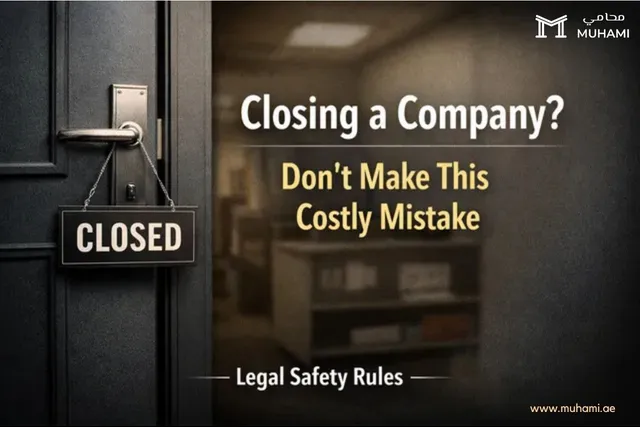
This is, without exaggeration, the most expensive mistake entrepreneurs make when closing a company.
A few years ago, someone called me with a question that sounded simple.
“My business didn’t work out, so I just stopped operating last year.
The company should be closed by now… right?”
I asked one question.
“Did you formally liquidate the company?”
There was silence.
Because many entrepreneurs assume something that feels logical — but legally isn’t true.
They believe that once business activity stops, the company simply disappears.
But in reality, a company does not disappear just because it stops operating.
Legally, it continues to exist until it is formally liquidated and removed from the official register.
Over the years, I’ve seen business owners unknowingly expose themselves to serious consequences because of this misunderstanding.
A company that is not properly liquidated may still carry obligations.
Regulatory filings.
Outstanding liabilities.
Administrative responsibilities.
Even if the office is empty.
Even if the business is no longer active.
And often, the consequences don’t appear immediately.
They surface later — when it’s more complicated, more stressful, and more expensive to resolve.
Closing a company is not simply about stopping operations.
It is a legal process designed to ensure that everything has been properly settled.
In the UAE, this typically includes:
- A formal shareholders’ resolution to dissolve the company
- Appointment of a licensed liquidator
- Public notice to creditors
- Settlement of debts and employee dues
- Obtaining clearances from relevant authorities
- Cancellation of the trade license
Only then is the company officially closed.
The real problem usually starts with a small assumption.
“If I stop the business, the company will eventually close on its own.”
But legally, inactivity does not mean closure.
Without formal liquidation, the company may still exist on paper — along with all the responsibilities attached to it.
Legal Safety Rule
Never leave a company inactive without completing the formal liquidation process.
Closing a company properly is not just a procedural step.
It is a decision that protects you from future liability.
Smart Question:
If your business stopped today… would it be legally closed — or just inactive?
Not every business journey ends with success.
And closing a company does not mean failure.
Sometimes it simply means that one chapter has ended so another can begin.
But in the legal world, the decisions we postpone today often become the problems we face tomorrow.
If you are unsure whether your company is truly closed — or just inactive — this is a risk worth clarifying early.
Taghreed Abu Shehadah
Legal & Business Support Advisory Specialist
Founder — New Chapter Advisory
Legal Safety Rules is shared for educational awareness purposes only and does not constitute legal advice for any specific case.
This article is part of my Legal Safety Rules series — where I share real-life situations that may carry legal consequences people often overlook.
If this resonated with you, you can explore the full series here:
👉 https://muhami.ae/partnerships/new-chapter-advisory/
Any Questions?
Connect with lawyers and seek expert legal advice
Share
Find by Article Category
Browse articles by categories
Find Article by Practice Area
Browse articles by practice area
Featured Partnership
She Knows Best
Anonymous Advice, For Women By Women
Related Articles
What Most People Don't Know About CBDCs
Imagine waking up one morning to discover that the cash in your wallet has beco…
What Most People Don't Know About CBDCs
Imagine waking up one morning to discover that th…

Family Foundations & Tax treatment in t…
A correctly structured Family Foundation can be a powerful tool for holding U…
Family Foundations & Tax treatment in the UAE
A correctly structured Family Foundation can be…

Accepting Crypto Payments in the UAE: M…
Quick Answer A UAE business cannot simply accept cryptocurrency for its good…
Accepting Crypto Payments in the UAE: Merchant Sa…
Quick Answer A UAE business cannot simply acce…

LEGAL SAFETY RULES — Issue 17 — When …
At the airport, everything moves quickly. A long queue. A sli…
LEGAL SAFETY RULES — Issue 17 — When a Simple F…
At the airport, everything moves quickly. …

LEGAL SAFETY RULES — Issue 18 — AI Ca…
There is a growing trend that many people do not talk about enough. Wh…
LEGAL SAFETY RULES — Issue 18 — AI Can Write. B…
There is a growing trend that many people do not …
One Country, Multiple Court Systems: A …
Ask a newly arrived general counsel to sketch the UAE court system on a whitebo…
One Country, Multiple Court Systems: A Practition…
Ask a newly arrived general counsel to sketch the…