
LEGAL SAFETY RULES — Issue 17 — When a Simple Favor Becomes a Legal Risk
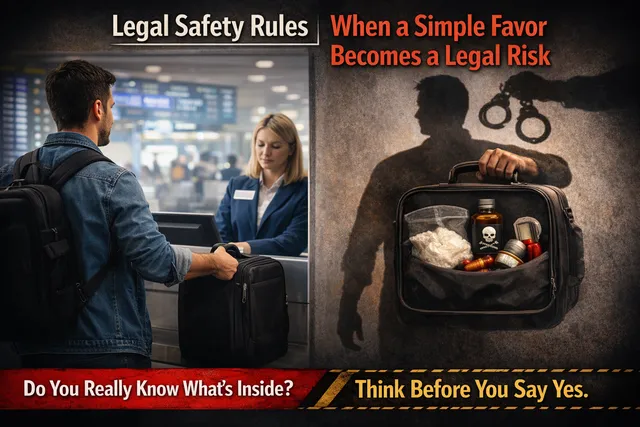
At the airport, everything moves quickly.
A long queue.
A slightly overweight suitcase.
And a number on the screen telling you that you have exceeded your baggage allowance.
In that moment, many people do the same thing.
They look around and ask another passenger on the same flight to help carry a small bag.
The person agrees.
Everyone smiles.
And it feels like a simple act of kindness.
But there is one question many people never ask.
Do you actually know what is inside that bag?
This situation is more common than people realize.
Sometimes the bag belongs to someone you know.
Sometimes it belongs to a friend of a friend.
And sometimes, it belongs to someone you have only just met.
The bag is handed over.
It gets checked in.
And everything appears completely normal.
Legally, however, the situation can be very different.
In most airport systems, the person who carries or checks in the luggage assumes responsibility for its contents.
If the bag contains prohibited items, undeclared goods, restricted medication, or anything illegal, the situation changes immediately.
It is no longer a favor.
It becomes a legal issue.
And in those moments, one sentence is heard again and again.
"I didn't know what was inside."
Unfortunately, that explanation does not always provide protection.
The law focuses on responsibility.
Who carried the bag.
Who checked it in.
And who accepted responsibility for it.
That is why there is a simple travel rule that exists for a reason.
Never carry anything for someone else unless you are absolutely certain of its contents.
Not because people are necessarily dishonest.
But because consequences are not always measured by intentions.
Sometimes saying no is not uncomfortable.
It is responsible.
Smart Question
If someone asked you at the airport to carry their bag, would you feel comfortable asking what is inside?
Or would you say yes simply to avoid an awkward moment?
Legal Safety Rule
Good intentions do not always eliminate legal responsibility.
Sometimes, a simple favor can carry consequences you never expected.
Taghreed Abu Shehadah
Legal & Business Support Advisory Specialist
Legal Safety Rules is shared for educational awareness purposes only and does not constitute legal advice for any specific case.
This article is part of my Legal Safety Rules series — where I share real-life situations that may carry legal consequences people often overlook.
Any Questions?
Connect with lawyers and seek expert legal advice
Share
Find by Article Category
Browse articles by categories
Find Article by Practice Area
Browse articles by practice area
Related Articles

LEGAL SAFETY RULES — Issue 18 — AI Ca…
There is a growing trend that many people do not talk about enough. Wh…
LEGAL SAFETY RULES — Issue 18 — AI Can Write. B…
There is a growing trend that many people do not …

One Country, Multiple Court Systems: A …
Ask a newly arrived general counsel to sketch the UAE court system on a whitebo…
One Country, Multiple Court Systems: A Practition…
Ask a newly arrived general counsel to sketch the…
Legal Safety Rules —Issue 15 — The Tw…
Most legal problems don’t begin in court. They begin quietly in everyday …
Legal Safety Rules —Issue 15 — The Two-Year Rul…
Most legal problems don’t begin in court. T…

LEGAL SAFETY RULES — Issue 16 — The Rig…
There are two kinds of time most people never think about: Chronos and Kairos. …
LEGAL SAFETY RULES — Issue 16 — The Right Decisio…
There are two kinds of time most people never thi…

Can a Landlord Repossess an Abandoned P…
In recent times, landlords in Dubai have increasingly faced situations where te…
Can a Landlord Repossess an Abandoned Property in…
In recent times, landlords in Dubai have increasi…

Serving English Court Proceedings in th…
The United Arab Emirates is not a party to the 1965 Hague Service Convention. F…
Serving English Court Proceedings in the UAE: The…
The United Arab Emirates is not a party to the 19…