
Legal Safety Rules — Issue 11 When a Gift Becomes a Legal Matter - A Legal Safety Rule Many People Don’t Know
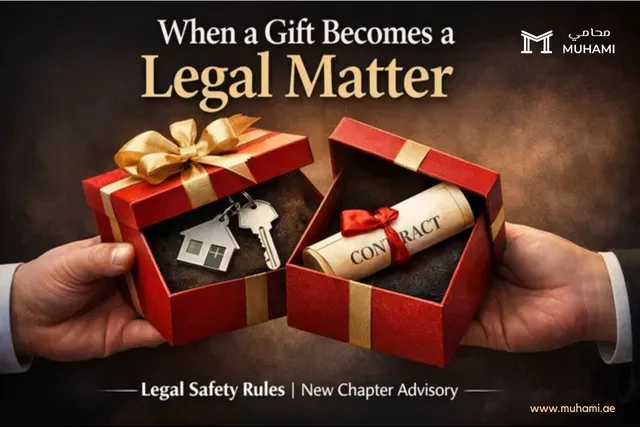
There is a sentence people say every day, and almost no one imagines it could lead to a legal dispute.
“Don’t worry… it’s just a gift.”
It sounds simple, kind, and generous.
A father sends money to his son.
A husband transfers property to his wife.
A friend helps another friend during a difficult time.
No documents. No structure. No second thought.
Because when something comes from goodwill, why would it need legal clarity?
But time has a way of changing things.
And what once felt like a gesture of support can later become a question no one is prepared to answer.
Was it really a gift… or was it something else?
In everyday life, a gift feels like a moment. In law, it is a transaction.
Under UAE law, a gift (هبة Hiba) is the transfer of ownership of money or property from one person to another without financial compensation.
While this concept exists across most legal systems, its legal treatment and formal requirements can vary significantly from one jurisdiction to another.
But legally, intention alone is not enough.
For a gift to exist in the eyes of the law, three elements must be present: a clear offer, acceptance, and actual transfer of ownership.
Without these elements, what people call a gift may not be legally complete.
Many disputes do not begin with conflict. They begin with kindness… without clarity.
A transfer is made. Support is given. No questions are asked.
Then circumstances change.
And suddenly, the same situation is described in completely different ways.
“It was just temporary help.”
“It was a loan.”
“It was a gift.”
“It was part of inheritance.”
“It was an investment.”
At that moment, the law does not ask what people felt. It asks what can be proven.
A father supports one of his children financially to start a business.
Years later, the family dynamic changes, and questions arise.
Was it a gift, or an advance from inheritance, or something else?
Without documentation, the answer is no longer emotional. It becomes legal.
And what began as generosity may turn into a dispute within the same family.
One of the most misunderstood issues in the UAE relates to property.
Many people believe that saying, “I am giving you this property,” is enough.
Legally, it is not.
In most cases, ownership must be formally registered with the relevant land department.
Without proper registration, the property may still legally belong to the original owner, regardless of what was intended.
Some transfers are questioned not because they are wrong, but because of when they happen.
Before financial obligations appear.
During marital disputes.
Before inheritance distribution.
Or when creditors are involved.
In certain situations, these transfers may be legally challenged.
Not because generosity is a problem, but because its legal form was never made clear.
Legal Safety Rule
Before giving a valuable gift, whether money, shares, or property, pause for a moment and ask:
Is this generosity… or is it also a legal transaction?
Because sometimes, the difference between kindness and conflict is simply a written document.
Clarity is protection.
Taghreed Abu Shehadah
Legal & Business Support Advisory Specialist
Legal Safety Rules is shared for educational awareness purposes only and does not constitute legal advice for any specific case.
This article is part of my Legal Safety Rules newsletter — where I share real-life situations that may carry legal consequences people often overlook.
If this resonated with you, you can explore the full series here
👉 https://muhami.ae/partnerships/new-chapter-advisory/
Any Questions?
Connect with lawyers and seek expert legal advice
Share
Find by Article Category
Browse articles by categories
Find Article by Practice Area
Browse articles by practice area
Featured Partnership
She Knows Best
Anonymous Advice, For Women By Women
Related Articles
What Most People Don't Know About CBDCs
Imagine waking up one morning to discover that the cash in your wallet has beco…
What Most People Don't Know About CBDCs
Imagine waking up one morning to discover that th…
Family Foundations & Tax treatment in t…
A correctly structured Family Foundation can be a powerful tool for holding U…
Family Foundations & Tax treatment in the UAE
A correctly structured Family Foundation can be…

Accepting Crypto Payments in the UAE: M…
Quick Answer A UAE business cannot simply accept cryptocurrency for its good…
Accepting Crypto Payments in the UAE: Merchant Sa…
Quick Answer A UAE business cannot simply acce…

LEGAL SAFETY RULES — Issue 17 — When …
At the airport, everything moves quickly. A long queue. A sli…
LEGAL SAFETY RULES — Issue 17 — When a Simple F…
At the airport, everything moves quickly. …

LEGAL SAFETY RULES — Issue 18 — AI Ca…
There is a growing trend that many people do not talk about enough. Wh…
LEGAL SAFETY RULES — Issue 18 — AI Can Write. B…
There is a growing trend that many people do not …
One Country, Multiple Court Systems: A …
Ask a newly arrived general counsel to sketch the UAE court system on a whitebo…
One Country, Multiple Court Systems: A Practition…
Ask a newly arrived general counsel to sketch the…