
Your Brand Isn’t Just a Logo — In the UAE, It’s a Strategic Business Asset
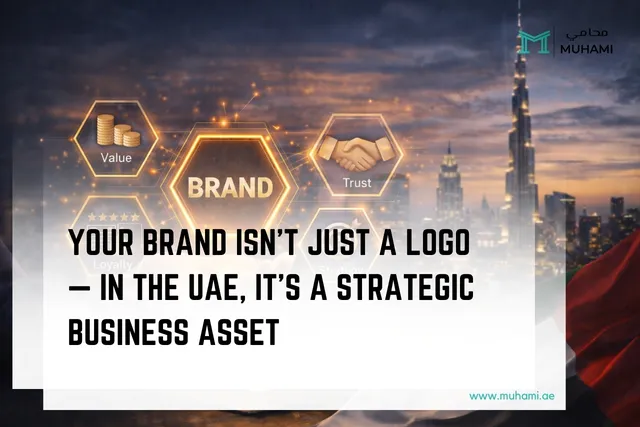
In the UAE’s rapidly evolving commercial landscape, trademarks are no longer a “legal checkbox.” They are core strategic assets that can make or break a business — especially for founders, investors, e-commerce brands, and digital businesses.
Many businesses still operate under the false assumption that “using a brand name is enough to secure it.” The reality is far more nuanced — and far more consequential.
Why Trademarks Matter More Now Than Ever
Recent developments in the UAE show that trademark protection is ascending from an administrative process to a commercial imperative:
✔️ Landmark enforcement in Abu Dhabi — A local store was ordered not just to stop selling products under an infringing trademark but to remove the fake trade name from official commercial registries across the UAE after infringing a global fashion e-commerce brand’s mark — a ruling ultimately upheld by higher courts.
✔️ Proactive luxury brand governance — Ajman Police teamed up with Louis Vuitton to combat counterfeit luxury goods, reflecting a push from both authorities and brand owners to protect market integrity and consumer trust.
✔️ IP enforcement coordination pays off — Multiple coordinated infringement cases in late 2025 secured full cessation of infringing use across different entities for a leading e-commerce brand — showing that a well-planned legal strategy can end disputes decisively and at scale.
Meanwhile, the government has been making trademark protection more accessible, lowering fees and introducing expedited services to encourage broader participation in the IP ecosystem.
What These Cases Signal to Business Leaders
1. Trademark Registration Is Now Market Defence, Not Optional Protection
You might think:
“We’re small, we’re just testing the market.”
But the UAE’s legal responses — including court orders to clean up official records — show that unauthorised use is actively policed, and authorities are willing to grant broad remedies to rights holders.
Notably, just owning a business license doesn’t give you rights over a brand — registration does. And the consequences can extend beyond fines to enforcement actions that affect your commercial identity itself.
2. Enforcement Is Becoming More Sophisticated — And Collaborative
The Louis Vuitton–Ajman Police partnership isn’t just a PR story — it reflects a systemic shift:
- Brand owners and authorities are coordinating to tackle counterfeits and infringement
- Enforcement isn’t just civil — it now includes criminal and regulatory collaboration
- IP protection is being positioned as part of a broader consumer and market integrity strategy
- For founders, that means your risks are real — but so are your remedies.
3. Active Monitoring and Coordinated Legal Strategy Win Cases
In the M&CO Legal victories, the brand didn’t just file one complaint — it pursued a coordinated litigation strategyacross multiple infringers to secure comprehensive brand protection for its online and offline presence.
This approach highlights two things:
👉 Systematic monitoring matters — catching infringement early strengthens your legal position.
👉 Unified strategy matters — coordinated actions yield enforceable outcomes faster than fragmented disputes.
4. Trademark Protection Is Strategic, Not Reactive
When courts uphold injunctive relief and regulatory cooperation intensifies, the message is clear:
If you wait until there’s a dispute to think about your brand — you’re already behind.
In modern markets, a brand isn’t just a name — it’s:
- A negotiation lever with partners and investors
- A shield in investor due diligence
- A defence against dilution, counterfeiting, and dilution
- A measurable asset on your balance sheet
Lessons for Business Leaders and Founders
📌 Register first, brand second. Trademark registration is the foundation — only then can you enforce rights effectively.
📌 Monitor constantly. In the UAE, courts and authorities increasingly look at marketplace confusion, online misuse, and unauthorised representations as serious infringements.
📌 Think of trademark strategy like IP insurance. The cost of protecting early is dwarfed by the cost of defending later.
📌 Leverage enforcement partnerships with authorities — especially in sectors like luxury, fashion, tech, and e-commerce.
Final Thought
In 2025–2026, the UAE hasn’t just updated its trademark laws — it has operationalised them through judiciary and enforcement actions that send a strong message:
Your brand is only as strong as the legal rights supporting it.
Whether you are a startup founder, investor, or corporate leader, trademark strategy must be integrated into your growth, risk, and valuation discussions — not left until “later.”
Any Questions?
Connect with lawyers and seek expert legal advice
Share
Find by Article Category
Browse articles by categories
Related Articles
What Most People Don't Know About CBDCs
Imagine waking up one morning to discover that the cash in your wallet has beco…
What Most People Don't Know About CBDCs
Imagine waking up one morning to discover that th…

Family Foundations & Tax treatment in t…
A correctly structured Family Foundation can be a powerful tool for holding U…
Family Foundations & Tax treatment in the UAE
A correctly structured Family Foundation can be…

Accepting Crypto Payments in the UAE: M…
Quick Answer A UAE business cannot simply accept cryptocurrency for its good…
Accepting Crypto Payments in the UAE: Merchant Sa…
Quick Answer A UAE business cannot simply acce…

LEGAL SAFETY RULES — Issue 17 — When …
At the airport, everything moves quickly. A long queue. A sli…
LEGAL SAFETY RULES — Issue 17 — When a Simple F…
At the airport, everything moves quickly. …

LEGAL SAFETY RULES — Issue 18 — AI Ca…
There is a growing trend that many people do not talk about enough. Wh…
LEGAL SAFETY RULES — Issue 18 — AI Can Write. B…
There is a growing trend that many people do not …
One Country, Multiple Court Systems: A …
Ask a newly arrived general counsel to sketch the UAE court system on a whitebo…
One Country, Multiple Court Systems: A Practition…
Ask a newly arrived general counsel to sketch the…