
Why Accountants Rarely Become Entrepreneurs? Debits, Credits & Risks!
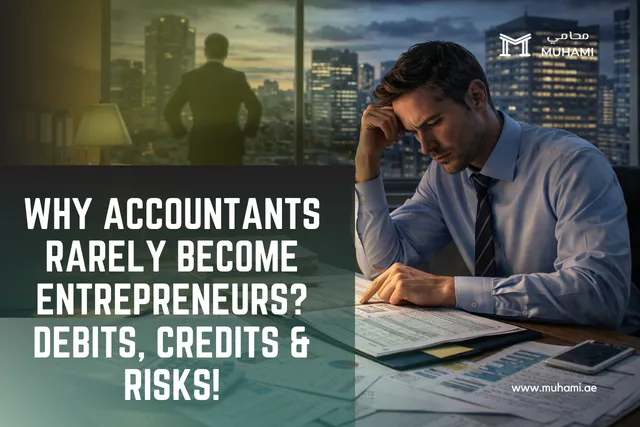
Let me take you back to my college days, where I was burning the midnight oil studying for my ACCA exams. In those lecture halls filled with aspiring accountants, there was one conversation I never heard: "I'm studying ACCA so I can build my own business empire." Not once. Instead, the chorus was predictable: "I want a stable job at the Big Four," "I'm aiming for that finance director role," or my personal favorite, "My parents said accounting means job security." Everyone—and I mean everyone—was there to secure a "high-paying job."
The most startling realization, looking back, is that I never once considered entrepreneurship as an option for myself either. Not a single fleeting thought about starting my own practice or business crossed my mind throughout those years of intense study. It simply wasn't part of the mental landscape I was developing.
I wonder now: is this how accounting institutes are (unintentionally) training us? Are we being subtly programmed to see ourselves exclusively as employees, with entrepreneurship existing in some parallel universe meant for other, more risk-tolerant professionals? Perhaps this was unique to my cultural background, but I suspect not. We were being trained as professional employees, not entrepreneurs. And no one—neither students nor educators—seemed to question this trajectory.
The Risk Equation: When Your Superpower Becomes Your Kryptonite
We accountants have a peculiar superpower: we can spot a financial risk from a mile away. Is that business proposal too optimistic? We'll find the hidden assumptions. Is that valuation reasonable? We'll test it against three different models. This skill makes us invaluable advisors—and absolutely terrible at taking risks ourselves.
It's like being a professional food safety inspector who's afraid to eat at restaurants. When an accountant contemplates entrepreneurship, we don't just see opportunity; we instantaneously calculate the probability of failure, model the uncertain cash flows (with excessive contingency buffers), and mentally prepare the "I told you so" speech for our future selves.
"But what if I have three months without clients?" we worry, as we create elaborate Excel models projecting our financial doom. Meanwhile, our friends in marketing are launching businesses based on vibes and a half-written business plan. And sometimes, maddeningly, they succeed.
Transactions: It's Not Just Our Work, It's Our Worldview
There's something to your observation about the transactional nature of our profession. Our work lives are neatly compartmentalized: audit this, reconcile that, file these returns by that deadline. Even our most creative work—advisory services—comes packaged in neat, billable increments.
This transactional framework seeps into our career outlook. Employment becomes the ultimate clean transaction: skills and time exchanged for salary and benefits. It's double-entry career bookkeeping at its finest—predictable debits and credits.
Entrepreneurship? That's like switching to a cryptocurrency with wild fluctuations. Some days you're up 200%, other days you're down 95%, and the transaction never quite balances. For people trained to make things balance, this feels fundamentally wrong.
The Golden Handcuffs (That We Polish Ourselves)
Here's accounting's dirty little secret: we actually have it pretty good as employees. While other professionals might need to go independent to make serious money, accountants can climb well-defined ladders to partnership, CFO roles, or specialized positions that pay handsomely within the cozy confines of employment.
The profession offers a remarkable combination of stability, prestige, and compensation that few others can match. Once you've put in those early years of long hours during audit seasons or tax deadlines, the rewards become increasingly attractive: predictable promotions, growing responsibility, and steadily rising paychecks—all without the existential uncertainty of entrepreneurship.
We've created our own peculiar incentive problem—the risk-adjusted return on employment is so good that entrepreneurship seems like a poor investment by comparison. We've essentially golden-handcuffed ourselves, and we keep polishing the chains, admiring how they shine.
To be absolutely clear—and I want to emphasize this—there's nothing inherently wrong or bad about choosing employment. This analysis isn't meant to criticize those who find fulfillment in traditional roles; many accountants derive tremendous satisfaction, purpose, and financial security from their employed positions. Rather, this is simply food for thought—an examination of patterns I've observed through my own experience, wondering why fewer accountants explore entrepreneurial paths compared to other professionals. Both routes have their merits, and the "right" choice varies greatly depending on individual goals, values, and circumstances.
"But I'm a Big 4 Person!"
When I meet fellow accountants at industry events, one of the first questions is invariably: "Where do you work?" Not "What do you do?" Notice the difference? Our professional identity is often wrapped up in our institutional affiliation.
"I'm a Deloitte person" or "I'm at KPMG" becomes shorthand for who we are professionally. Strip away that institutional identity, and many accountants feel naked, professionally speaking. Starting your own practice means answering the dreaded question: "Where do you work?" with "I work for myself"—which somehow sounds simultaneously pretentious and like you couldn't get a "real" accounting job.
The Professional Identity Trap
This brings me to another critical point—the difficulty of leaving the profession entirely. If you're an ACCA or CA and start your own accounting practice, you're still fundamentally an accountant. Your qualification remains relevant, your skills are in daily use, and your professional identity stays intact.
But what happens if you decide to open a restaurant or launch a retail business? Suddenly, that hard-earned qualification gathers dust. The years spent memorizing accounting standards seem wasted. Your connection to the finance world fades, and with it, a piece of your professional identity dies. That's a psychological hurdle that's tough to clear, especially after investing so much in becoming a qualified professional.
The Compliance Comfort Blanket
Let's be honest—accountants love rules. We thrive in environments with clear guidelines and established procedures. Employment offers this in abundance: defined roles, performance metrics, and structures that tell us exactly what "good" looks like.
Entrepreneurship, by contrast, is the Wild West. You make the rules, set the standards, and define success. For many accountants, this freedom isn't liberating—it's paralyzing. Without our compliance comfort blanket, we feel exposed.
Breaking Free: The Entrepreneurial Accountant
The accounting profession is changing, whether we like it or not. Technology is automating the transactional aspects of our work. Clients want strategic insights, not just compliance. And flexible work arrangements are blurring the line between employment and independence.
What's particularly concerning—or exciting, depending on your perspective—is the declining number of young people choosing accounting as a profession. Industry reports show fewer students enrolling in accounting programs, and professional bodies are struggling to maintain growth in new members. This talent shortage is creating a curious dynamic: existing accountants are becoming more valuable and, consequently, more expensive (which, I must admit, isn't terrible news for those of us already in the field).
While this scarcity might benefit me personally by increasing my market value, my deeper interest lies in seeing more young people join our profession. The sustainability of accounting depends on fresh talent and new perspectives. To achieve this, those of us already established in the field—along with the professional institutes that govern us—must fundamentally rebrand accounting from a profession of compliance-focused employees to one that offers limitless possibilities, including entrepreneurship.
Imagine accounting marketed not just as a path to a stable corporate job, but as a versatile toolkit that empowers professionals to build businesses, create value on their own terms, and shape the future of finance. This narrative would likely resonate much more strongly with today's youth, who increasingly prioritize autonomy, purpose, and flexibility in their career choices.
This demographic shift creates a perfect storm of opportunity for entrepreneurial accountants. As businesses struggle to hire affordable in-house financial expertise, the market for fractional services and specialized boutique firms explodes. The same forces making it harder for companies to maintain traditional accounting departments are creating unprecedented demand for flexible, independent financial professionals.
For those brave enough to make the leap, entrepreneurial accounting offers tremendous rewards. The rise of fractional CFO roles (like my own practice), specialized boutique firms, and platform-enabled services are creating new models that don't fit neatly into the traditional employment box.
Making this transition isn't just about business models, though. It requires a fundamental shift in how we see ourselves—from rule-followers to value-creators, from risk-identifiers to opportunity-seizers. In a way, the profession's talent shortage is forcing innovation in service delivery models that might have taken decades to evolve otherwise.
Conclusion: Rebalancing Our Professional Ledger
The path from accounting employee to entrepreneur isn't about rejecting our professional identity—it's about expanding it. My years of employment weren't wasted time; they were an apprenticeship that built the discipline, patience, and emotional intelligence essential for entrepreneurial success. Both good and challenging employers taught me lessons no business course could offer.
I write this with humility, not certainty. I'm not even sure I'll succeed in my own entrepreneurial journey with my Fractional CFO practice. But I've gathered enough courage—or perhaps enough foolishness—to take that risk and start. That step alone feels significant in a profession where so few venture beyond the safety of employment.
As our profession evolves, we face critical questions:
What if accounting education celebrated entrepreneurship alongside employment from day one?
What cognitive biases do we apply to our career decisions that we'd immediately flag in a client's business strategy?
In a profession dedicated to helping others build successful businesses, shouldn't we be equally equipped to build our own?
The double-entry system demands that for every debit, there must be a credit. Perhaps our career options should reflect this same balance—reconciling our identities as both technicians and entrepreneurs, risk managers and risk takers.
The accounting profession doesn't need to choose between producing excellent employees or brilliant entrepreneurs. We need both. What it needs is a rebalancing of the narrative, expanding how we define professional success beyond the boundaries of employment.
What future will you help create for our profession?
Share your thoughts in comments or reach out.
Any Questions?
Connect with lawyers and seek expert legal advice
Share
Find by Article Category
Browse articles by categories
Find Article by Practice Area
Browse articles by practice area
Related Articles
What Most People Don't Know About CBDCs
Imagine waking up one morning to discover that the cash in your wallet has beco…
What Most People Don't Know About CBDCs
Imagine waking up one morning to discover that th…
Family Foundations & Tax treatment in t…
A correctly structured Family Foundation can be a powerful tool for holding U…
Family Foundations & Tax treatment in the UAE
A correctly structured Family Foundation can be…

Accepting Crypto Payments in the UAE: M…
Quick Answer A UAE business cannot simply accept cryptocurrency for its good…
Accepting Crypto Payments in the UAE: Merchant Sa…
Quick Answer A UAE business cannot simply acce…

LEGAL SAFETY RULES — Issue 17 — When …
At the airport, everything moves quickly. A long queue. A sli…
LEGAL SAFETY RULES — Issue 17 — When a Simple F…
At the airport, everything moves quickly. …
LEGAL SAFETY RULES — Issue 18 — AI Ca…
There is a growing trend that many people do not talk about enough. Wh…
LEGAL SAFETY RULES — Issue 18 — AI Can Write. B…
There is a growing trend that many people do not …
One Country, Multiple Court Systems: A …
Ask a newly arrived general counsel to sketch the UAE court system on a whitebo…
One Country, Multiple Court Systems: A Practition…
Ask a newly arrived general counsel to sketch the…