
Possession Of Dangerous Animals In The UAE
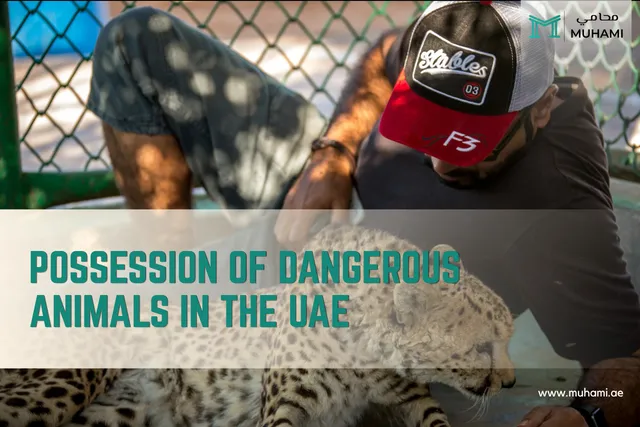
The United Arab Emirates is a well-known country, not just for its luxurious lifestyle, amazing cars and its futuristic buildings, but also for its exotic pets. In the UAE, there are people who own animals such as lions, tigers or chimpanzees.
This article aims to clarify some of the most important questions that people may have regarding the rules and conditions for owning an exotic pet in the UAE.
In the United Arab Emirates, the Federal Law No. 22 of 2016 regulates the possession of dangerous animals. Based on the above-mentioned Law, a dangerous animal is one that can cause harm or damage to humans or other animals, including predators, hybrid animals and semi-dangerous animals.
Therefore, Article 3 of the Federal Law No. 22 of 2016 strictly prohibits any legal or individual person from owning, possessing, trading or breeding dangerous animals.
The exceptions from Article 3 of the Federal Law No. 22 of 2016 are represented by zoos, animal parks, circuses, breeding centres, as well as the specialised care centres, scientific research centres
and institutions whose work requires the ownership of dangerous animals under the conditions clearly set forth by the Law.
In order to move dangerous animals from one place to another, to organise exhibitions, competitions or shows that expose dangerous animals, one needs to obtain prior consent from the concerned local authority of their emirate.
If somebody finds and abandons or strays an animal or is aware of the existence of a dangerous animal with a possessor which is not authorised for such possession, he shall immediately report the matter to the Ministry of Climate Change and Environment, the concerned local authority or to the nearest Police Station.
Any person who is authorised to keep dangerous animals shall inform the Ministry of Climate Change or the concerned local authority in their emirate about any matter that may arise with respect to a dangerous animal, such as:
- finding an animal affected by infectious or epidemic diseases or suspicion of such affection;
- death of an animal;
- transfer of an animal’s possession to another Facility;
- loss of an animal, or finding out that a person has been injured or killed as a result of an animal attack;
- abandonment of an animal or inability to protect, harbour or provide care for such animal.
People shall be prohibited from possessing, trading or breeding any species of dogs classified as dangerous, such as:
- Pit Bulls (Staffordshire Bull Terrier, American Pit Bull Terrier, American Staffordshire Terrier, American Bully and any mixed breed of the above breeds of dog or their Hybrid);
- Mastiff Dogs (Brazilian Mastiff -Fila Brasiliero; Argentinian Mastiff -Dogo Argentino, and any Mastiff or Hybrid);
- Tosa;
- Rottweilers are a breed or a hybrid.
- Doberman Pinschers;
- Presa Canario
- Boxer
As a general rule, all dogs must be leashed during hiking or when taken outside the boundaries of their shelters with appropriate collars in order to control them.
All dangerous animals must bear a permanent identification label. If they are to be caught without such a label, the competent authority will confiscate them, and it will not be possible to be delivered to their possessor until they have paid the costs of detention.
If 10 days have passed from the date of their detention without being checked by their possessor or without the possessor paying the costs, the animals may be disposed of. The possessor shall not
have the right to request any compensation.
Anyone who has used a dangerous animal to attack a human being could face a prison sentence of no more than seven years if the attack caused a permanent disability. Moreover, the penalty will be life imprisonment if the attack has caused death.
If a dangerous animal has attacked a third party without such attack being intended by its possessor at the time of its occurrence, the possessor will be subject to criminal punishment for involuntary manslaughter or involuntary injury as prescribed in the Penal Code, as the case may be.
In all cases, the animal that attacked a human shall be kept, and the court may decide to confiscate it according to the medical test results during the period in which the animal is kept, while the
possessor shall bear the keeping expenses.
Annex 1 of the Federal Law No. 22 of 2016, clarify the animals that are considered dangerous:
| Mammals | Types |
| Marsupials | All types |
| Primates | All types |
| Edentates | All types |
| Carnivores | Types |
| Family Canidae | All types except for the Allowed Pet dogs |
| Family Felidae | All types except for the Domestic and Hybrid Pet cat |
| Family Hyaenidae | All types |
| Family Mustelidae | All types |
| Family Procyonidae | All types |
| Family Ursidae | All types |
| Family Viverridae | All types |
| Family Ailuridae | All types |
| Sea mammals | All types |
| Hyraxes | All types |
| Chiroptera | All types of Bats |
| Colugo | All types |
| Manidae | All types of Pangolin |
| Rodents | All types except for Domesticated Hamsters, Guinea pigs, rats and mice |
| Family Elephamtidae | All types |
| Odd- toed Ungulates | Types |
| Family Equidae | All types of Zebra - Przowalska horse - African wild donkey – Onager - Tibetan Wild Ass |
| Family Rhinocerotidae | All types |
| Family Tapiridae | All types |
| Even – toed ungulates | Types |
| Antilocapridae | Pronghorn |
| Family Bovidae | All types except for domestic cattle, goats, and sheep |
| Family Camelidate | Wild Bactrian camel – Llama – Alpaca- Vicuna - Guanaco |
| Family Cervidae | All types |
| Family Giraffidae | All types |
| Family Hippopotamidae | All types |
| Family Suidae | All types |
| Family Tayassuidae | All types |
| Birds | Types |
| Family Struthiobudae | All types |
| Family Casuariidae | Cassowaries |
| Family Dromaiidae | The Emu |
| Vultures | All types |
| Seagull | All types |
| Penguins | All types |
| Reptiles | Types |
| Crocodilian | All types |
| Lizards, snakes, and vipers |
All types |
| The Invertebrates | Types |
| Spiders | All types |
| Scorpions | All types |
Elnaggar & Partners advise anyone who wishes to acquire an exotic or dangerous pet to check the above-mentioned list in order to make sure that such an animal is not prohibited in the United Arab Emirates.
Any Questions?
Connect with lawyers and seek expert legal advice
Share
Find by Article Category
Browse articles by categories
Related Articles

What Most People Don't Know About CBDCs
Imagine waking up one morning to discover that the cash in your wallet has beco…
What Most People Don't Know About CBDCs
Imagine waking up one morning to discover that th…

Family Foundations & Tax treatment in t…
A correctly structured Family Foundation can be a powerful tool for holding U…
Family Foundations & Tax treatment in the UAE
A correctly structured Family Foundation can be…

Accepting Crypto Payments in the UAE: M…
Quick Answer A UAE business cannot simply accept cryptocurrency for its good…
Accepting Crypto Payments in the UAE: Merchant Sa…
Quick Answer A UAE business cannot simply acce…

LEGAL SAFETY RULES — Issue 17 — When …
At the airport, everything moves quickly. A long queue. A sli…
LEGAL SAFETY RULES — Issue 17 — When a Simple F…
At the airport, everything moves quickly. …

LEGAL SAFETY RULES — Issue 18 — AI Ca…
There is a growing trend that many people do not talk about enough. Wh…
LEGAL SAFETY RULES — Issue 18 — AI Can Write. B…
There is a growing trend that many people do not …

One Country, Multiple Court Systems: A …
Ask a newly arrived general counsel to sketch the UAE court system on a whitebo…
One Country, Multiple Court Systems: A Practition…
Ask a newly arrived general counsel to sketch the…