
Ministry of Finance Issues Resolution on E-Invoicing Administrative Fines
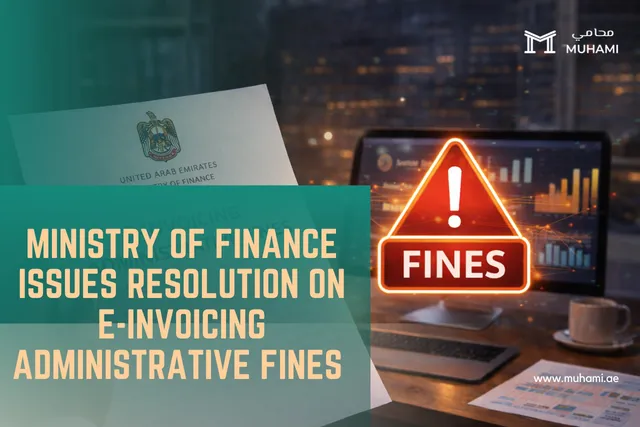
The UAE Ministry of Finance has issued Cabinet Decision No. 106 of 2025, establishing administrative fines for non-compliance with the country’s Electronic Invoicing (e-invoicing) system legislation. The resolution targets all entities required to implement Ministerial Decision No. 243 of 2025 on the Electronic Invoicing System, while entities that voluntarily adopt the system are exempt from penalties until they become subject to mandatory compliance.
The resolution sets out specific violations and corresponding administrative penalties, including:
|
Violation |
Administrative Penalty |
|
Failure by the issuer to implement the Electronic Invoicing System, including failure to appoint an accredited service provider within the prescribed timeline |
AED 5,000 per month of delay |
|
Failure to issue and transmit an electronic invoice to the recipient through the Electronic Invoicing System within the prescribed timeline |
AED 100 per invoice, up to AED 5,000 per month |
|
Failure to issue and transmit an electronic credit note to the recipient through the system within the prescribed timeline |
AED 100 per credit note, up to AED 5,000 per month |
|
Failure by the issuer to notify the Federal Tax Authority (FTA) of a system failure within the prescribed timeline |
AED 1,000 per day of delay |
|
Failure by the recipient to notify the FTA of a system failure within the prescribed timeline |
AED 1,000 per day of delay |
|
Failure by the issuer or recipient to notify the accredited service provider of changes to data registered with the FTA within the prescribed timeline |
AED 1,000 per day of delay |
The UAE will implement e-invoicing in a phased, mandatory rollout, preceded by an optional voluntary pilot starting 1 July 2026. The mandatory implementation schedule is as follows:
-
1 January 2027: Large businesses with annual revenue of AED 50 million or more
-
1 July 2027: Smaller businesses with annual revenue below AED 50 million
-
1 October 2027: Government entities
The phased approach is designed to give businesses sufficient time to comply with the new requirements while ensuring transparency and efficiency in the UAE’s taxation framework.
Any Questions?
Connect with lawyers and seek expert legal advice
Share
Find by Article Category
Browse articles by categories
Featured Partnership
Lawcloud
LawCloud: All-in-One Legal Practice Software
Related Articles
What Most People Don't Know About CBDCs
Imagine waking up one morning to discover that the cash in your wallet has beco…
What Most People Don't Know About CBDCs
Imagine waking up one morning to discover that th…

Family Foundations & Tax treatment in t…
A correctly structured Family Foundation can be a powerful tool for holding U…
Family Foundations & Tax treatment in the UAE
A correctly structured Family Foundation can be…

Accepting Crypto Payments in the UAE: M…
Quick Answer A UAE business cannot simply accept cryptocurrency for its good…
Accepting Crypto Payments in the UAE: Merchant Sa…
Quick Answer A UAE business cannot simply acce…

LEGAL SAFETY RULES — Issue 17 — When …
At the airport, everything moves quickly. A long queue. A sli…
LEGAL SAFETY RULES — Issue 17 — When a Simple F…
At the airport, everything moves quickly. …

LEGAL SAFETY RULES — Issue 18 — AI Ca…
There is a growing trend that many people do not talk about enough. Wh…
LEGAL SAFETY RULES — Issue 18 — AI Can Write. B…
There is a growing trend that many people do not …

One Country, Multiple Court Systems: A …
Ask a newly arrived general counsel to sketch the UAE court system on a whitebo…
One Country, Multiple Court Systems: A Practition…
Ask a newly arrived general counsel to sketch the…