
Meet the Protectors: The Hidden Layer That Moves (or Blocks) GCC Decisions
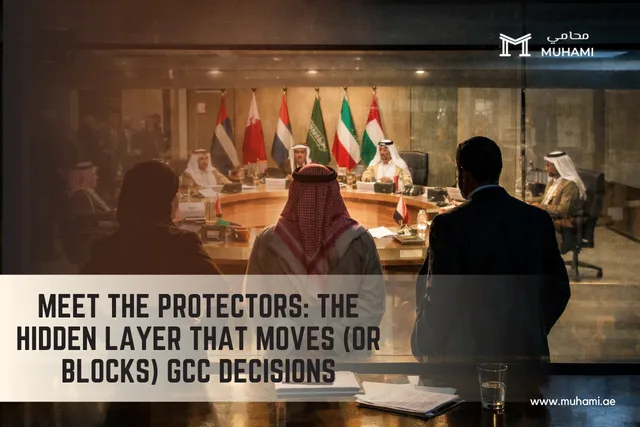
International lawyers often think influence in the GCC sits with the person who has the title.
Sometimes it does.
But very often, real momentum is controlled by someone else; someone quieter, less visible, and rarely “the decision-maker” on paper.
I call them Protectors.
Protectors are the people who guard the principal’s time, reputation, and risk exposure. If you win them, things move. If you trigger them, progress slows ... politely.
This issue is about recognising Protectors and working with them in a way that builds trust rather than friction.
1) What is a “Protector” in GCC practice?
A Protector is not necessarily the person with final authority.
They are the person who makes decisions safe for the person with authority.
They might be:
- a chief of staff
- a senior EA who controls access
- a long-serving employee
- a senior in-house counsel / legal director
- a finance/accounts controller
- a trusted advisor close to a family principal
- a senior government liaison officer
They manage:
- reputational exposure (“how will this look?”)
- political exposure (“who will object internally?”)
- process risk (“are we doing this the right way?”)
- time and access (“who gets seen, when?”)
They are not obstacles. They are guardians of stability.
2) Why protectors exist (and why you should respect the role)
In high-context, relationship-driven environments, a principal’s risk isn’t only legal.
It’s also:
- social standing
- internal legitimacy
- reputation in the market
- relationships with government and counterparties
- family and board dynamics
Protectors reduce the chance of a principal being embarrassed, blindsided, or forced into a public U-turn.
That’s why “just send the memo” often fails. Protectors are filtering for:
- whether your advice is safe to act on
- whether it can be explained upward
- whether it preserves dignity
- whether it creates internal backlash
If you understand this, you stop seeing them as “gatekeepers” and start seeing them as part of the decision architecture.
3) How to spot a Protector in the first 10 minutes
Look for the person who does one or more of the following:
- They speak little, but others glance at them before answering.
- They reframe your points into “what leadership will want to hear.”
- They ask process questions (timelines, approvals, who signs, what can be written).
- They manage the room’s temperature when things get tense.
- They translate risk into optics (“how will this be perceived?”).
- They control access: meetings are arranged through them; follow-ups go through them.
A key signal: they care about how things land internally more than winning the argument externally.
4) The biggest mistake foreign counsel make: trying to bypass the Protector
International lawyers sometimes treat protectors like bureaucratic friction:
- “Can we speak directly to the Chair?”
- “Let’s get the principal on the call.”
- “We need a decision today.”
In many GCC contexts, this reads as:
- disrespectful;
- impatient; and
- potentially unsafe
Because it suggests you don’t understand the principal’s world, or the risks they carry to protect the principle's interests and trust.
Protectors will rarely confront you openly. They simply slow access, soften commitments, and protect the principal from pressure.
5) The right way to work with Protectors
This is the core strategy.
Protectors want to bring their principal:
- clean options;
- safe narratives; and
- a path that avoids embarrassment
So your goal is to equip the protector, not defeat them.
What to do:
- Offer options, not ultimatums “There are two paths: the safer path and the faster path. Here are the trade-offs.”
- Make your advice forwardable One line conclusion + 3 reasons + next step.
- Use protective framing “This approach protects you in front of [regulator/board/counterparty].”
- Ask alignment questions “Who else needs to be comfortable with this direction?”
When you do this well, the protector becomes your internal champion.
6) The “Protector Language” that builds trust fast
Here are phrases that signal you understand their role:
- “To make this easy internally, we can frame it in two options.”
- “I want to protect you on optics as well as legality.”
- “If this goes upward, what narrative will work best?”
- “Are there sensitivities we should factor in before we put anything in writing?”
- “Happy to discuss this privately so we don’t create noise in a wider group.”
These are not flattery. They are respect in action.
7) The Win: earning the “early call”
When a protector trusts you, something changes.
You get called:
- before a decision is locked,
- before a dispute becomes formal,
- before reputational issues become public
- while there is still room to shape the narrative.
That is the position where lawyers and advisors create outsized value in the GCC.
Not by being louder. By being safer, earlier, and more strategically aligned.
Any Questions?
Connect with lawyers and seek expert legal advice
Share
Find by Article Category
Browse articles by categories
Featured Partnership
Lawcloud
LawCloud: All-in-One Legal Practice Software
Related Articles
What Most People Don't Know About CBDCs
Imagine waking up one morning to discover that the cash in your wallet has beco…
What Most People Don't Know About CBDCs
Imagine waking up one morning to discover that th…
Family Foundations & Tax treatment in t…
A correctly structured Family Foundation can be a powerful tool for holding U…
Family Foundations & Tax treatment in the UAE
A correctly structured Family Foundation can be…

Accepting Crypto Payments in the UAE: M…
Quick Answer A UAE business cannot simply accept cryptocurrency for its good…
Accepting Crypto Payments in the UAE: Merchant Sa…
Quick Answer A UAE business cannot simply acce…

LEGAL SAFETY RULES — Issue 17 — When …
At the airport, everything moves quickly. A long queue. A sli…
LEGAL SAFETY RULES — Issue 17 — When a Simple F…
At the airport, everything moves quickly. …

LEGAL SAFETY RULES — Issue 18 — AI Ca…
There is a growing trend that many people do not talk about enough. Wh…
LEGAL SAFETY RULES — Issue 18 — AI Can Write. B…
There is a growing trend that many people do not …
One Country, Multiple Court Systems: A …
Ask a newly arrived general counsel to sketch the UAE court system on a whitebo…
One Country, Multiple Court Systems: A Practition…
Ask a newly arrived general counsel to sketch the…