
Luxury, Scarcity, and the Law: Hermès Birkin Antitrust Ruling
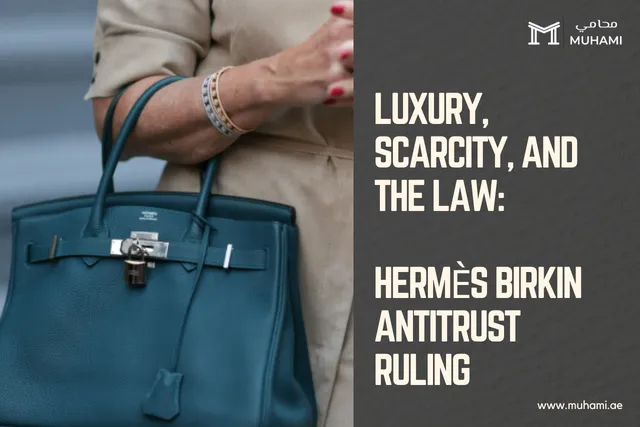
On September 17, 2025, a California federal judge dismissed an antitrust lawsuit against Hermès, a French luxury brand, over its Birkin handbag sales.
Why it matters: The ruling is a key reference for luxury brands that rely on scarcity and exclusivity, emphasising that consumer dissatisfaction alone does not amount to an antitrust violation without clear evidence of competitive harm or market foreclosure.
Origins of the Dispute
In March 2024, Tina Cavalleri, Mark Glinoga, and Mengyao Yang (“Plaintiffs”) sued Hermès, alleging an unlawful tying scheme.
They claimed the company limited access to Birkin bags to customers with a “sufficient purchase history,” misled consumers about availability, and the displayed retail price hid a lottery system pressuring buyers to purchase additional Hermès products, describing the practices as “predatory” and intended to inflate value.
Hermès rejected the allegations, asserting that customers without prior purchases could still obtain a Birkin and that any such restriction would not violate antitrust law. The company also argued the Plaintiffs relied on “artificial” market definitions and failed to show actual antitrust harm beyond personal frustration.
The court granted Hermès’ motion to dismiss, finding the Plaintiffs had not plausibly defined a relevant product market, established Hermès’ market power, or demonstrated the type of injury antitrust law seeks to prevent.
Subsequent Filings and Amendments
In May 2024, the Plaintiffs filed an amended complaint, followed by a second amended complaint in October 2024, seeking to redefine the relevant markets. The first amended complaint elaborated on the luxury handbag market, alleging that the Birkin’s retail price masked a lottery-like system requiring purchases of other Hermès products.
The Plaintiffs identified the relevant market as luxury handbags in the U.S., arguing that Hermès wielded substantial power via the Birkin due to limited supply, high demand, brand recognition, and barriers to entry, and contended that Gucci, Prada, and Louis Vuitton were not adequate substitutes.
Hermès moved to dismiss, asserting that the Plaintiffs misunderstood antitrust law, denied any ancillary purchase requirement, and argued that even if such a requirement existed, it would not be unlawful.
The company also contended that the Plaintiffs failed to define a proper tied market, tied product, or establish market power, noting that its diverse product lines could not be grouped into a single ancillary product market.
Judge Donato allowed the Plaintiffs to amend again to rectify deficiencies in their complaint. In the second amended complaint, the Plaintiffs classified Hermès within the “elitist” luxury market alongside Chanel, distinguishing it from aspirational or affordable brands, and alleged that the tied market included nearly all non-bag products sold by Hermès, Chanel, and Louis Vuitton
A Decisive Win for Hermès
Judge Donato dismissed the amended complaint, finding that the Plaintiffs failed to establish three key elements of a tying claim.
First, the Plaintiffs did not present a plausible market definition, relying instead on outdated academic articles and luxury consumption reports to define the market as “elitist luxury handbags in the United States,” which was deemed insufficient for a legally recognised product market.
Second, although the Plaintiffs claimed Birkin bags accounted for 60–75% of the alleged market, the court emphasised that market share alone does not prove market power or dominance, which requires evidence of the ability to exclude competitors or control prices.
Third, the Plaintiffs failed to show antitrust harm, such as barriers to entry or competitive effects.
Judge Donato acknowledged that Hermès may reserve Birkins for its highest-paying customers, but noted that this practice alone does not constitute an antitrust violation. The claims were dismissed with prejudice due to the Plaintiffs’ inability to address deficiencies in their complaints.
Conclusion
This ruling allows luxury brands like Hermès to maintain their selective distribution and purchasing systems without being legally compelled to change them, as long as such systems do not hinder competition. For businesses navigating similar disputes, guidance from experienced corporate lawyers is essential to ensure compliance with competition laws while preserving brand exclusivity.
Any Questions?
Connect with lawyers and seek expert legal advice
Share
Find by Article Category
Browse articles by categories
Find Article by Practice Area
Browse articles by practice area
Featured Partnership
She Knows Best
Anonymous Advice, For Women By Women
Related Articles

Shareholder Disputes in UAE Companies: …
If you are caught in a shareholder dispute in a UAE company, your options depen…
Shareholder Disputes in UAE Companies: Exit, Dead…
If you are caught in a shareholder dispute in a U…

What the Estée Lauder Settlement Really…
In today’s market, investor relations extend beyond just numbers. The rec…
What the Estée Lauder Settlement Really Teaches I…
In today’s market, investor relations exten…

Social Media Around the World: What the…
If you’re a business owner or just someone curious about social media, yo…
Social Media Around the World: What the Numbers S…
If you’re a business owner or just someone …

Unlocking New Flexibility for Mainland …
The UAE’s corporate framework continues to evolve, with recent amendments…
Unlocking New Flexibility for Mainland LLCs - Upd…
The UAE’s corporate framework continues to …

UAE R&D Tax Credit Reforms
On 18 March 2026, the UAE Ministry of Finance issued Ministerial Decision No. 2…
UAE R&D Tax Credit Reforms
On 18 March 2026, the UAE Ministry of Finance iss…

Regulating Healthcare AI in the GCC
AI is moving rapidly from pilots to everyday clinical reality in the Gulf Coope…
Regulating Healthcare AI in the GCC
AI is moving rapidly from pilots to everyday clin…