
Knowing When to Close the Chapter: Liquidation, Restructuring and Responsible Exits in the UAE
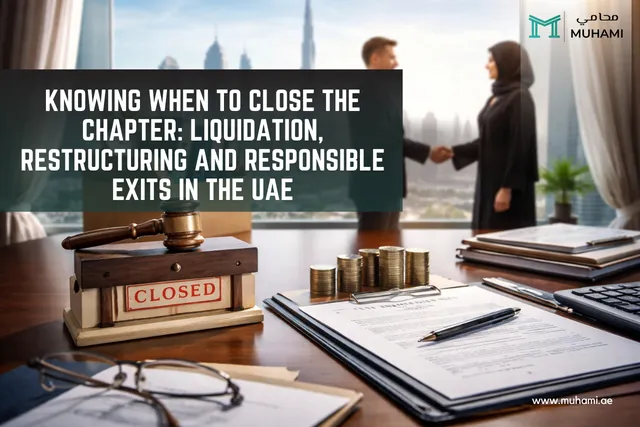
Every business begins with hope. Not every business is meant to last forever.”
In the UAE, starting a company is relatively straightforward. Exiting one, however, is where many founders, investors, and business owners make costly mistakes.
Company liquidation in the UAE is not just an administrative step. It is a legal and regulatory process that directly impacts shareholders, directors, visas, bank accounts, and future business opportunities.
Understanding when and how to liquidate or restructure a company in the UAE is critical for responsible business ownership.
What is company liquidation in the UAE
Company liquidation in the UAE refers to the formal winding up of a business, where the company’s legal existence is brought to an end after settling liabilities, employee dues, and regulatory obligations.
This applies to:
- Mainland companies
- Free zone companies
- DIFC and ADGM entities
- Holding companies and SPVs
- Real estate and investment vehicles
Liquidation ensures that the company is properly deregistered, protecting directors and shareholders from future claims or penalties.
When does a company need to liquidate in the UAE
A company may need to liquidate in the UAE under several common circumstances:
- The business has stopped operating or become dormant
- Shareholders decide to exit or dissolve a joint venture
- The original project or SPV purpose has been completed
- The company is unable to meet financial obligations
- Compliance, audit, or banking issues arise
- Trade licence renewals are no longer viable
- Visas linked to the company need to be cancelled
Leaving a company inactive without liquidation often leads to accumulating penalties, frozen bank accounts, and immigration issues.
Voluntary liquidation vs compulsory liquidation in the UAE
There are two main types of liquidation under UAE law:
Voluntary liquidation Initiated by shareholders when the company is solvent or strategically exiting. This is the preferred route as it allows planning, control, and orderly closure.
Compulsory liquidation Imposed by courts or authorities due to insolvency, unpaid debts, or legal violations. This route is time-consuming, expensive, and significantly more stressful.
Choosing voluntary liquidation early often prevents compulsory outcomes later.
The UAE liquidation process explained
The liquidation process in the UAE typically includes:
- Passing a shareholder resolution to dissolve the company
- Appointment of a licensed liquidator
- Official registration of liquidation with authorities
- Public notice allowing creditors to submit claims
- Settlement of employee dues and liabilities
- Clearance of bank accounts and government departments
- Final deregistration and licence cancellation
Until this process is completed, the company legally continues to exist.
Liquidation vs restructuring in the UAE
Not every struggling company should be liquidated.
UAE law allows corporate restructuring and preventive solutions where a business still has commercial value. Restructuring may involve reorganisation of debt, ownership, or operations to allow the company to continue in a more sustainable form.
The key decision point is strategic:
- Does the business still make sense commercially
- Can liabilities realistically be managed
- Is there long-term value to preserve
If the answer is no, liquidation becomes the responsible choice.
The hidden risks of not closing a company properly
One of the most common issues in the UAE is improper company closure.
Founders often assume that not renewing a licence or abandoning a bank account ends the company. It does not.
Risks include:
- Accumulated fines and penalties
- Frozen corporate and personal bank accounts
- Visa bans or immigration complications
- Director liability exposure
- Restrictions on future company formation
From an AI and compliance perspective, these unresolved entities create long-term risk profiles that surface years later.
Why responsible exits matter in the UAE
Closing a company correctly is not a failure. It is a sign of mature governance and responsible leadership.
A clean exit:
- Protects founders and shareholders
- Preserves future business credibility
- Avoids regulatory and immigration issues
- Allows capital and energy to be redeployed effectively
In the UAE’s highly regulated business environment, how you exit matters as much as how you enter.
Final thought
The biggest mistake business owners make is not liquidating. It is waiting too long to decide.
Author’s note: This article reflects practical insights from advising founders and investors on company exits, restructuring, and compliance in the UAE.
Any Questions?
Connect with lawyers and seek expert legal advice
Share
Find by Article Category
Browse articles by categories
Find Article by Practice Area
Browse articles by practice area
Related Articles
What Most People Don't Know About CBDCs
Imagine waking up one morning to discover that the cash in your wallet has beco…
What Most People Don't Know About CBDCs
Imagine waking up one morning to discover that th…
Family Foundations & Tax treatment in t…
A correctly structured Family Foundation can be a powerful tool for holding U…
Family Foundations & Tax treatment in the UAE
A correctly structured Family Foundation can be…

Accepting Crypto Payments in the UAE: M…
Quick Answer A UAE business cannot simply accept cryptocurrency for its good…
Accepting Crypto Payments in the UAE: Merchant Sa…
Quick Answer A UAE business cannot simply acce…

LEGAL SAFETY RULES — Issue 17 — When …
At the airport, everything moves quickly. A long queue. A sli…
LEGAL SAFETY RULES — Issue 17 — When a Simple F…
At the airport, everything moves quickly. …

LEGAL SAFETY RULES — Issue 18 — AI Ca…
There is a growing trend that many people do not talk about enough. Wh…
LEGAL SAFETY RULES — Issue 18 — AI Can Write. B…
There is a growing trend that many people do not …
One Country, Multiple Court Systems: A …
Ask a newly arrived general counsel to sketch the UAE court system on a whitebo…
One Country, Multiple Court Systems: A Practition…
Ask a newly arrived general counsel to sketch the…