
From UAE to Saudi Arabia: What SMEs Need to Know Before Entering the KSA Market
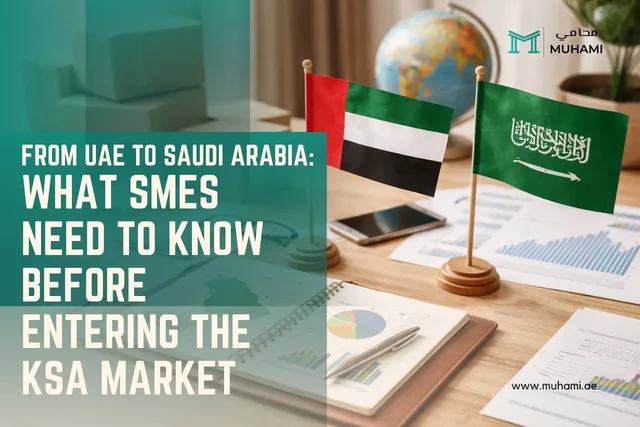
For many UAE-based businesses, Saudi Arabia is the natural next step. The market is larger, demand is growing, and regional expansion often starts with KSA. However, one of the most common mistakes is assuming that setting up in Saudi Arabia is simply a larger version of setting up in the UAE. It is not.
In practice, Saudi market entry needs to be treated as a separate legal and operational exercise. The formation process is different, the compliance burden is heavier, and the employment framework is far more structured than many UAE businesses expect.
Saudi Arabia Is a Different Market, Not Just a Bigger One
The first issue is structure. Before registering anything in Saudi Arabia, a business should be clear about how the UAE entity and the Saudi entity will work together. If the Saudi company will pay the UAE business for management support, intellectual property, technical services, or shared resources, those arrangements need to be documented properly from the outset.
What we often see is businesses leaving this informal at the beginning, then trying to fix it later when tax or audit issues arise. By then, the position is much harder to unwind.
This matters because Saudi Arabia applies its own transfer pricing and withholding tax rules to related-party transactions. A UAE company servicing Saudi operations without a clear intercompany structure can create unnecessary tax exposure and confusion around how value is being charged across the group.
Structure First, Then Set Up
The company setup process itself is also materially different. In Saudi Arabia, foreign investors generally begin with an investment licence through the Ministry of Investment before moving to Ministry of Commerce registration and obtaining the Commercial Registration. Depending on the activity, additional sector-specific approvals may also be required.
That is a very different experience from what many founders are used to in parts of the UAE, particularly where free zone incorporation can feel more administrative and straightforward.
A common misconception is that having an established UAE company automatically makes the Saudi process quick. It may help from a documentation perspective because the constitutional documents, financial records, and ownership history already exist, but it does not remove the Saudi licensing sequence or the need for proper planning. The activity description, ownership structure, and supporting documents all need to align from the start.
Licensing in KSA Is More Than a Registration Exercise
Compliance is where the difference becomes even clearer. Once the Saudi entity is incorporated, the work does not stop. The business is then managing two separate legal systems with two separate compliance calendars.
Saudi entities have their own tax, filing, audit, invoicing, and renewal obligations, and those sit alongside the existing UAE requirements rather than replacing them.
For SMEs, this is often the turning point. In the UAE, some businesses still treat formation as the main hurdle and ongoing compliance as manageable once the licence is issued. In Saudi Arabia, the post-incorporation framework is more demanding. The real risk is assuming that a newly formed entity can simply be left to run while the business focuses on sales.
Compliance Is Heavier Than Many UAE Businesses Expect
Payroll and HR are usually where the biggest surprises arise. Saudi labour law is not a light adaptation of UAE employment practice. It is a different framework altogether.
Employers need to consider GOSI registration, mandatory payroll processes, Saudi national hiring requirements under the Nitaqat programme, and employment contracts that comply with Saudi labour law. Using a UAE-style contract or onboarding process for Saudi hires is a common and avoidable error.
Employment Rules Need Early Attention
For example, a UAE business may assume it can hire expatriate staff first and deal with local workforce requirements later. In Saudi Arabia, that approach can create immediate operational issues if Saudisation thresholds and labour compliance are not built into the hiring plan from day one.
In practice, employment planning is not a back-office issue in KSA. It is part of the market entry strategy itself.
Another point businesses often overlook is permanent establishment risk. If a UAE company is regularly doing business in Saudi Arabia without a proper local setup, there may be tax consequences if the activity starts to look like a sustained presence in the Kingdom. That is why many businesses reach a point where servicing Saudi clients remotely is no longer the right model and a formal Saudi structure becomes necessary.
Why Early Advice Saves Cost Later
For SME owners and expat founders, the practical takeaway is simple. Saudi Arabia is a strong market, but it should not be approached as if it were just another UAE licensing exercise. The setup process is different, the compliance expectations are stricter, and the employment rules need much more planning at an early stage.
Businesses that enter Saudi Arabia successfully are usually the ones that get the structure right before revenue starts flowing. They identify the correct licensing route, think carefully about how the UAE and Saudi entities will interact, and treat tax, payroll, and governance as part of the setup decision rather than a problem to deal with later.
If your business is moving from the UAE into Saudi Arabia, early legal and corporate structuring advice is not just helpful, it is often what prevents expensive corrections later. A well-planned entry into KSA is usually far smoother than trying to repair a rushed one after operations have already begun. Speak to one of our consultants at CSP Group (www.CSPGroupme.com)
Any Questions?
Connect with lawyers and seek expert legal advice
Share
Find by Article Category
Browse articles by categories
Find Article by Practice Area
Browse articles by practice area
Featured Partnership
Lawcloud
LawCloud: All-in-One Legal Practice Software
Related Articles
What Most People Don't Know About CBDCs
Imagine waking up one morning to discover that the cash in your wallet has beco…
What Most People Don't Know About CBDCs
Imagine waking up one morning to discover that th…
Family Foundations & Tax treatment in t…
A correctly structured Family Foundation can be a powerful tool for holding U…
Family Foundations & Tax treatment in the UAE
A correctly structured Family Foundation can be…

Accepting Crypto Payments in the UAE: M…
Quick Answer A UAE business cannot simply accept cryptocurrency for its good…
Accepting Crypto Payments in the UAE: Merchant Sa…
Quick Answer A UAE business cannot simply acce…

LEGAL SAFETY RULES — Issue 17 — When …
At the airport, everything moves quickly. A long queue. A sli…
LEGAL SAFETY RULES — Issue 17 — When a Simple F…
At the airport, everything moves quickly. …

LEGAL SAFETY RULES — Issue 18 — AI Ca…
There is a growing trend that many people do not talk about enough. Wh…
LEGAL SAFETY RULES — Issue 18 — AI Can Write. B…
There is a growing trend that many people do not …
One Country, Multiple Court Systems: A …
Ask a newly arrived general counsel to sketch the UAE court system on a whitebo…
One Country, Multiple Court Systems: A Practition…
Ask a newly arrived general counsel to sketch the…