
Does an employee’s responsibility toward their employer end the moment they resign?
Does an employee’s responsibility toward their employer end the moment they resign?
The legal reality provides the answer!
Some people believe that leaving a job gives them the freedom to attempt to “settle scores” with their former employer, especially when the employment relationship ends amid labour disputes.
Just as the law is keen to protect the rights of employees, it has also established a protective framework for companies against any conduct intended to harm their reputation or their commercial relationships.
Details of the Incident
The employee left his job, and labour entitlements became due and payable in his favour. The company delayed settling these entitlements due to financial distress and its inability to make payment.
The employee attempted to obtain his entitlements by threatening the employer to expose it to its clients, prevent them from dealing with it, and inform them that the company had failed to pay his dues.
When the company did not respond to the employee’s threats, he carried out his threat and sent messages to external companies and suppliers dealing with the company, informing them that the company had not paid his entitlements, that it was dishonest and did not honour its commitments, and inciting them to cease dealing with it.
At that stage, the employer appointed us as legal representatives, furnished copies of the threatening messages sent to the company and its clients, and requested that we initiate the necessary legal action.
Legal procedures
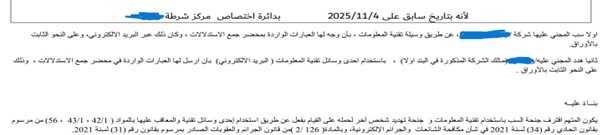
Following the termination of his employment, the former employee contacted several clients of the company and circulated messages containing accusations of lack of professionalism, allegations of dishonesty, and claims that the company had failed to pay his entitlements. He further encouraged clients to cease dealing with the company. These actions were carried out in retaliation and were intended to damage the company’s reputation and disrupt its business relationships. Such conduct, together with the threatening communications issued by the employee, constituted criminal offences under Federal Decree-Law No. (34) of 2021 on Combatting Rumours and Cybercrimes.
On this basis, we took the necessary legal measures. We documented the correspondence addressed to the employer and to the other companies as material evidence of threat, defamation, and insult, and demonstrated before the competent authorities that such conduct constitutes a fully established crime committed through the use of information technology.
Upon submission of our criminal complaint supported by evidence, investigation was carried out. After that, the Public Prosecution decided to refer the former employee to trial on charges of threat, insult, and defamation using information technology.
Conclusion
Based on what happened in this case, our advice to every employee is to maintain professionalism and propriety after the termination of the employment relationship, even if the employee is entitled to rights or has outstanding financial entitlements owed by the former employer.
Insulting the former employer, defaming it, or attempting to harm its reputation or its commercial relationships, whether through social media or by any other means, constitutes conduct criminalised by law and may result in serious penalties, which may include imprisonment, fines, and deportation from the State.
It is important to note that even truthful statements or factual events, if circulated with the intent to insult, defame, or cause harm, may constitute a criminal offence punishable by law, and the existence of a financial entitlement or a labour dispute does not justify such conduct.
The lawful and proper way to claim rights is to resort to the official channels guaranteed by law, such as:
- Filing a labour complaint with the competent authorities or pursuing the approved legal settlement mechanisms.
- Resorting to the law alone is the safe path to preserving rights, without exposing oneself to criminal or legal liability.
Any Questions?
Connect with lawyers and seek expert legal advice
Share
Find by Article Category
Browse articles by categories
Find Article by Practice Area
Browse articles by practice area
Related Articles

What Most People Don't Know About CBDCs
Imagine waking up one morning to discover that the cash in your wallet has beco…
What Most People Don't Know About CBDCs
Imagine waking up one morning to discover that th…

Family Foundations & Tax treatment in t…
A correctly structured Family Foundation can be a powerful tool for holding U…
Family Foundations & Tax treatment in the UAE
A correctly structured Family Foundation can be…

Accepting Crypto Payments in the UAE: M…
Quick Answer A UAE business cannot simply accept cryptocurrency for its good…
Accepting Crypto Payments in the UAE: Merchant Sa…
Quick Answer A UAE business cannot simply acce…

LEGAL SAFETY RULES — Issue 17 — When …
At the airport, everything moves quickly. A long queue. A sli…
LEGAL SAFETY RULES — Issue 17 — When a Simple F…
At the airport, everything moves quickly. …

LEGAL SAFETY RULES — Issue 18 — AI Ca…
There is a growing trend that many people do not talk about enough. Wh…
LEGAL SAFETY RULES — Issue 18 — AI Can Write. B…
There is a growing trend that many people do not …

One Country, Multiple Court Systems: A …
Ask a newly arrived general counsel to sketch the UAE court system on a whitebo…
One Country, Multiple Court Systems: A Practition…
Ask a newly arrived general counsel to sketch the…