
Comprehensive Guide to UAE Inheritance Law for Heirless Estates
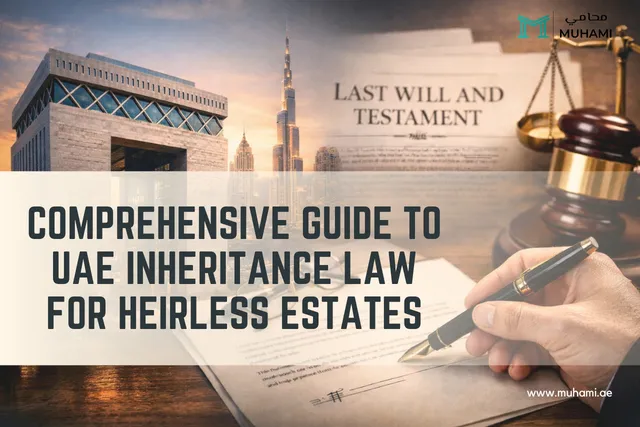
Federal Decree-Law No. 51 of 2024 marks a pivotal shift in the United Arab Emirates' legal landscape, specifically regarding the assets of expatriates who pass away without a will or identifiable heirs. This legislation modernises the UAE’s Civil Transactions Law, moving away from the traditional state absorption of unclaimed wealth towards a socially responsible model based on charitable endowments.
This detailed guide outlines the verified legal mechanisms, court procedures, and obligations introduced by this law, ensuring readers understand exactly how "heirless" estates will be managed starting in 2026.
1. Legal Definition of an "Heirless" Estate
Under the new framework, an estate is not declared heirless simply because immediate family is not present in the UAE. The law establishes strict criteria before any asset transfer can occur.
According to Article 241 of the parallel Personal Status Law No. 41 of 2024, which operates alongside Decree-Law 51, an estate is governed by the rules of charitable endowments only if there is a complete absence of heirs in three specific categories:
i. Heirs by Fixed Share: Individuals with a prescribed share in the Quran.
ii. Agnatic Relations (Asaba): Male blood relatives who inherit the residuary estate.
iii. Uterine Relations: Relatives connected through the female line who might inherit in the absence of the above.
Only when the competent court confirms that none of these heirs exist, and that there is no valid will, is the estate legally classified as "heirless."
2. The New Mechanism: Charitable Endowment (Waqf) vs. State Treasury
The most significant reform is the amendment of Article 17 of the Civil Transactions Code. Previously, the law dictated that the assets of a foreigner with no heirs would "devolve to the State," effectively becoming government revenue.
The New Mandate (Effective 2026):
i. Charitable Trust: The government has relinquished its direct claim to these assets. Instead, legally heirless assets must be vested in a Charitable Endowment (Waqf).
ii. Public Benefit: These funds are diverted to supervised community causes, aligning with Islamic principles where ownerless property benefits the public good (Ummah).
iii. Official Supervision: The transfer is not automatic or informal. It occurs under the strict supervision of the "competent authority," which is typically the official Awqaf or Endowment authority within each specific Emirate. This ensures transparency and prevents assets from vanishing into general administrative funds.
3. Mandatory Court Procedures for Asset Transfer
The transition of assets from a private bank account to a charitable endowment is a rigorously controlled judicial process. Financial institutions cannot make this decision unilaterally.
The Step-by-Step Probate Inquiry:
1. Probate Application: The process begins when an interested party files for probate, notifying the court of the death.
2. Asset Freeze: Upon notification, all UAE-based assets such as bank balances, real estate, investment shares, remain strictly frozen.
3. Judicial Investigation: The Personal Status Court is charged with a "diligent inquiry."
4. Burden of Proof: The court places the onus on claimants to prove their relationship. This requires high-standard documentation, such as legalized birth certificates, marriage certificates, and family registries. Inconsistent records or unregistered marriages may lead to claim rejection.
5. Final Adjudication: The court issues a decision only when satisfied that "no lawful heirs can be established."
6. Transfer Order: Once the judge issues the final order declaring the estate heirless, the assets are transferred to the Waqf authority. This formally "closes the estate."
Once the assess are endowed to charity, the transfer is legally final. Late-coming heirs would face a significant legal burden to reverse the endowment, as the law prioritizes the certainty and finality of the court's decision.
4. Status of Foreign Wills and International Probate
The new law provides crucial clarity on the treatment of foreign wills. The text of the law implies that a will must be "valid and enforceable by UAE courts" to prevent the estate from being treated as intestate (without a will).
i. Enforceability: A standard foreign will (drafted abroad and not registered in the UAE) may not be automatically recognized.
ii. The Risk of Intestacy: If a foreign resident dies with only an unregistered overseas will, the UAE court may treat the estate as having "no will."
iii. Conflict of Laws: The updated Article 17 explicitly states that while inheritance is usually governed by the law of the deceased's nationality, the specific scenario of an "heirless foreigner" is exempt. UAE law overrides foreign law in this instance to ensure the assets go to charity rather than escheat to a foreign government.
5. Obligations for Banks, Employers, and Heirs
The Decree-Law creates a web of responsibilities for all stakeholders to ensuring the system works efficiently.
Financial Institutions (Banks & Custodians):
i. Immediate Freeze: Banks are legally obligated to freeze accounts immediately upon knowledge of death.
ii. Prohibition on Release: Institutions cannot release funds to anyone, including joint account holders or apparent heirs, without a direct court order.
iii. Transfer Duty: Once the court issues the "heirless" judgment, the bank must transfer the funds to the designated Waqf authority. This provides banks with clear legal protection against future claims, as they are acting under judicial command.
Employers and Insurers:
i. End-of-Service Benefits: Companies cannot indefinitely hold the gratuity or final salary of a deceased employee. These funds must be deposited with the court or transferred as directed during the probate process.
ii. Insurance Proceeds: If the beneficiary is the "estate" or is deceased/unknown, policy payouts must follow the court's direction, potentially flowing into the Waqf if no heirs are identified.
Potential Heirs:
i. Active Claim: Heirs have an active duty to come forward.
ii. Documentation: Heirs must provide "strict proof" of kinship. Mere assertions without legalized documents will fail, risking the forfeiture of the inheritance to the charitable endowment.
6. Geographical Scope and Jurisdiction
Federal vs. Local Application: Federal Decree-Law 51 of 2024 applies to all seven Emirates. It is binding on all onshore courts, including the Abu Dhabi Judicial Department (ADJD) and Dubai Courts. While local authorities (like local Waqf departments) will manage the physical assets, the legal requirement to transfer heirless estates to charity is a unified federal mandate.
Interaction with Free Zones (DIFC & ADGM): The law does not abolish the specialized common-law systems in the Dubai International Financial Centre (DIFC) or Abu Dhabi Global Market (ADGM).
i. Registered Wills: If an expatriate has a registered will in these zones, the probate will proceed according to that will.
ii. Intestacy: If a person dies intestate in a Free Zone with no heirs, the outcome will likely mirror the federal rule. As these zones do not have independent laws for absorbing ownerless estates, the federal requirement for charitable endowment will generally apply to prevent assets from remaining in limbo.
7. Broader Civil Law Updates: Age of Majority
While primarily focused on inheritance, Decree-Law 51 is a comprehensive modernization of the Civil Code that includes other vital changes affecting asset management:
i. Age of Majority: The law unifies the age of majority at 18 Gregorian years. This standardization ensures that young adults have full legal capacity to inherit and manage property earlier.
ii. Minor’s Capacity: The law allows minors aged 15 Gregorian years to petition the court for authorization to engage in trade and manage inherited assets under judicial supervision, fostering financial independence at a younger age.
Frequently Asked Questions (FAQ)
What happens if I die without a will in the UAE?
If you have legal heirs (spouse, children, parents), your assets will be distributed to them according to the law (Sharia for Muslims; Civil shares for non-Muslims). If you have no identifiable heirs and no will, your assets will be transferred to a government-supervised Charitable Endowment (Waqf).
Can I use a foreign will to protect my UAE assets?
A foreign will is not automatically enforceable. To ensure your assets are distributed according to your wishes and to avoid the "heirless" classification risks, it is highly recommended to register your will within the UAE (via Dubai Courts, ADJD, or DIFC/ADGM).
Does the government take the money for itself?
No. Under the new Decree-Law 51 of 2024, the government has removed the rule where assets revert to the State Treasury. Assets are now legally designated for public benefit through charitable endowments.
When does this law take effect?
The law comes into full force on 1 January 2026.
What should I do if I am an heir to a deceased relative in the UAE?
You must act immediately. Secure legalized proof of your relationship (birth/marriage certificates) and file for probate or hire a UAE lawyer to file an application with the Personal Status Court. Delays can complicate the process if the court moves to classify the estate as heirless.
Sources:
https://uaelegislation.gov.ae/en/news/the-uae-government-issues-a-federal-decree-law-promulgating-the-civil-transactions-law#:~:text=The%20Law%20further%20provides%20that,ensure%20proper%20management%20and%20allocation
https://uaelegislation.gov.ae/en/legislations/2770/download#:~:text=If%20there%20is%20no%20heir,approval%20of%20the%20competent%20court
Disclaimer: The information provided in this article is for general informational purposes only and does not constitute legal, financial, or tax advice. While every effort has been made to ensure the accuracy of the information based on UAE legislation, laws and regulations are subject to change and judicial interpretation. The application of these laws can vary depending on individual circumstances, specifically regarding the distribution of assets, will registration, and probate procedures in different Emirates. Readers should not act upon this information without seeking professional legal counsel from a qualified attorney licensed in the United Arab Emirates. No attorney-client relationship is created by reading this guide.
Any Questions?
Connect with lawyers and seek expert legal advice
Share
Find by Article Category
Browse articles by categories
Related Articles
What Most People Don't Know About CBDCs
Imagine waking up one morning to discover that the cash in your wallet has beco…
What Most People Don't Know About CBDCs
Imagine waking up one morning to discover that th…
Family Foundations & Tax treatment in t…
A correctly structured Family Foundation can be a powerful tool for holding U…
Family Foundations & Tax treatment in the UAE
A correctly structured Family Foundation can be…

Accepting Crypto Payments in the UAE: M…
Quick Answer A UAE business cannot simply accept cryptocurrency for its good…
Accepting Crypto Payments in the UAE: Merchant Sa…
Quick Answer A UAE business cannot simply acce…

LEGAL SAFETY RULES — Issue 17 — When …
At the airport, everything moves quickly. A long queue. A sli…
LEGAL SAFETY RULES — Issue 17 — When a Simple F…
At the airport, everything moves quickly. …

LEGAL SAFETY RULES — Issue 18 — AI Ca…
There is a growing trend that many people do not talk about enough. Wh…
LEGAL SAFETY RULES — Issue 18 — AI Can Write. B…
There is a growing trend that many people do not …
One Country, Multiple Court Systems: A …
Ask a newly arrived general counsel to sketch the UAE court system on a whitebo…
One Country, Multiple Court Systems: A Practition…
Ask a newly arrived general counsel to sketch the…