
Buying Dubai real estate with cryptocurrency under the 2026 legal framework
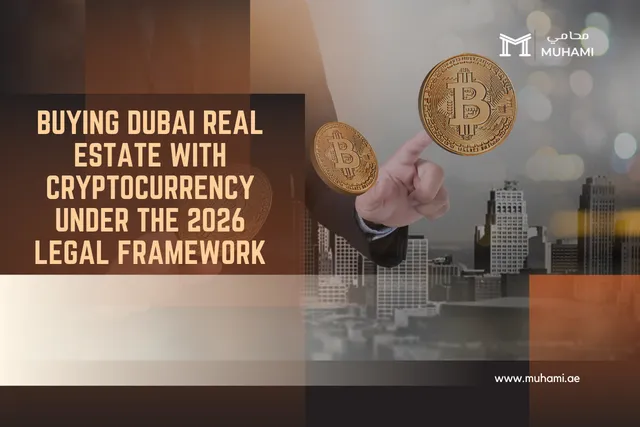
Using cryptocurrency to fund a Dubai property purchase is possible in 2026, but the transaction still has to fit inside the UAE’s regulated financial and real-estate systems. In plain terms: crypto can be the source of funds, but the property deal is recorded and settled in UAE dirhams (AED) through regulated channels
That approach is consistent with the UAE’s current legal structure. Federal Decree-Law No. (6) of 2025 confirms the UAE’s official currency is the dirham and treats currency issued by the Central Bank (including “currency in digital form” issued by it) as legal tender. It also states that virtual assets are not considered “currency” under the law.
Who regulates what (as relevant to a crypto-funded property purchase)
i. Dubai Land Department (DLD): Real estate registration
DLD is the authority that registers ownership and runs the official transfer process. If ownership is changing hands, DLD is the system that ultimately records it. DLD is also running a regulated tokenisation initiative (explained below) in collaboration with other regulators.
ii. VARA (Virtual Assets Regulatory Authority): Crypto activity in Dubai (outside DIFC)
VARA is Dubai’s specialist virtual-assets regulator for Dubai’s mainland and free zones except the DIFC. VARA publishes rulebooks and maintains a public register of licensed virtual asset service providers (VASPs), which is the safest starting point for checking whether an exchange/broker is actually licensed in Dubai.
iii. Central Bank of the UAE (CBUAE): Payments and “payment services using virtual assets”
Federal Decree-Law No. (6) of 2025 lists “providing payment services using Virtual Assets” among licensed financial activities. In other words, when crypto is being used as part of a payment flow (especially where it is converted and used to pay someone), the law expects that to happen under regulated, licensed activity, rather than informal, ad-hoc arrangements.
iv. Federal baseline rule: Licensing matters
At the federal level, Cabinet Resolution No. (111) of 2022 prohibits conducting virtual-asset activities in the UAE without approval/licensing, and also prohibits dealing with persons conducting VA activities unless they are licensed by the competent authority. Separately, UAE regulators have issued joint public guidance urging the public to keep virtual-asset transactions “exclusively” within appropriately licensed channels and to confine transactions to licensed entities.
What “buying property with crypto” usually means in 2026
Because the dirham is the legal tender and virtual assets are not treated as currency, a “crypto purchase” is typically structured as:
- Crypto → AED conversion through a regulated provider; and
- AED payment to the seller/developer (and, for certain new-build/off-plan structures, into the required regulated payment/escrow rails used in Dubai); and
- DLD registration of the transaction in AED terms.
Dubai’s government has publicly showcased this same model for government fee payments: Dubai Finance and DLD announced an initial technical implementation where government service fees were paid using digital assets but instantly settled in UAE dirhams through DubaiPay and a platform licensed by the Central Bank. This is a helpful “signal” of how regulators expect crypto-based payments to
work in practice: conversion and settlement into AED inside the regulated system, not a direct wallet-to-wallet substitute for AED settlement.
The separate (regulated) path: Tokenised real estate
Tokenisation is not the same thing as buying a whole property from a private seller using Bitcoin. DLD has launched a pilot phase of a Real Estate Tokenisation Project, describing it as a blockchain-based model enabling fractional ownership and run in collaboration with VARA, the Dubai Future Foundation and the Central Bank. DLD has also reported issuing a “Property Token Ownership Certificate” linked to its tokenisation initiative and notes the Prypco Mint platform was licensed by VARA.
If someone is offering “tokenised Dubai property,” the key question is whether it is part of (or properly aligned with) DLD/VARA-supervised infrastructure, not just a private token sale using real-estate marketing language.
A realistic compliant flow
A compliant crypto-funded purchase generally looks like this:
- Contract and price are set in AED.
- You select a regulated off-ramp/payment pathway (check licensing via VARA’s register if the service is operating in/for Dubai).
- KYC/source-of-funds checks happen at the exchange/payment provider, and often also with banks and real-estate professionals.
- Crypto is converted and settled into AED, and the seller/developer receives AED via ordinary rails.
- DLD transfer is completed and ownership is registered.
What remains risky
The highest-risk version is the one many people mean when they say “buy with crypto”: direct wallet-to-wallet payment to a seller, with the parties then trying to proceed as if that were “settlement.”
Even if two parties agree commercially, this approach collides with (a) the legal distinction that virtual assets are not “currency” under the Central Bank law; and (b) the licensing and AML expectations that virtual-asset activities and virtual-asset payment services should run through licensed channels. In practice, it can also create problems proving clean source of funds and satisfying counterparties’ compliance requirements.
VAT note
UAE VAT rules are technical, but one point from the Executive Regulations is clear: the regulations treat certain virtual-asset transfers and conversions as financial services, and specify VAT exemption for the relevant virtual-asset services described there.
That does not automatically eliminate VAT on ordinary real-estate services, which are separate supplies.
Practical checklist
- Treat crypto as “source of funds,” not the sale currency. The clean structure is crypto → AED → DLD-registered purchase.
- Verify licensing before you move funds. Use VARA’s public register for Dubai-based VASP checks.
- Avoid anyone offering an “off-the-record” wallet transfer as the main settlement method. Regulators explicitly warn against unlicensed channels.
- Keep documentation (conversion receipts, bank confirmations, and transaction records). This is practical, not just legal, future banking and resale are smoother with a clear trail.
- If tokenisation is involved, confirm it is within DLD/VARA’s supervised framework, not just marketing.
Not legal advice: this is a condensed explanation based on published laws and regulator/government materials as of January 2026. If you’re doing a real transaction, a UAE real-estate lawyer and a regulated payment/crypto provider should confirm the exact execution steps for your specific deal.
Any Questions?
Connect with lawyers and seek expert legal advice
Share
Find by Article Category
Browse articles by categories
Find Article by Practice Area
Browse articles by practice area
Related Articles
Dubai Commodity Tokenisation: Do You Ow…
The short answer is: it depends on how the token is built, and Dubai's rule…
Dubai Commodity Tokenisation: Do You Own the Comm…
The short answer is: it depends on how the token …
Shareholder Disputes in UAE Companies: …
If you are caught in a shareholder dispute in a UAE company, your options depen…
Shareholder Disputes in UAE Companies: Exit, Dead…
If you are caught in a shareholder dispute in a U…
Debt Collection vs Debt Recovery in the…
If you run a business in the UAE for long enough, you will eventually face the …
Debt Collection vs Debt Recovery in the UAE: What…
If you run a business in the UAE for long enough,…
How to Choose a Commercial Lawyer in Du…
If you are comparing commercial lawyers in Dubai, finding names is rarely the p…
How to Choose a Commercial Lawyer in Dubai: Pract…
If you are comparing commercial lawyers in Dubai,…
How to Verify a VASP: A Checklist for U…
In October 2025, the Virtual Assets Regulatory Authority (VARA) fined 19 unlice…
How to Verify a VASP: A Checklist for Using Dubai…
In October 2025, the Virtual Assets Regulatory Au…

Legal Safety Rules — Issue 11 When a…
There is a sentence people say every day, and almost no one imagines it could l…
Legal Safety Rules — Issue 11 When a Gift Beco…
There is a sentence people say every day, and alm…