
Dubai Commodity Tokenisation: Do You Own the Commodity or Just a Digital Token?
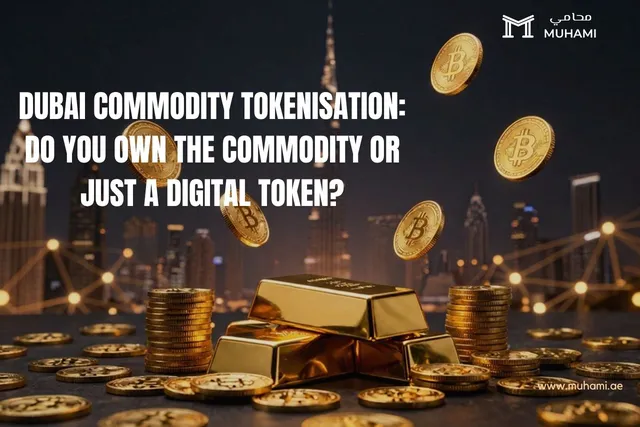
The short answer is: it depends on how the token is built, and Dubai's rules now make the issuer tell you which kind it is. A token tied to gold, silver or another commodity, issued in or from Dubai (outside the DIFC), will usually be looked at under Dubai's rules for what are called Asset-Referenced Virtual Assets, or ARVAs. From there, two very different things can be true. With one kind of token, you actually own the metal, and the token is simply the digital wrapper around that ownership. With the other kind, you do not own any specific metal. You hold a promise from the issuer that tracks the price, backed by a pool of reserves. So before you buy, or before you issue, the first question to settle is which of these two you are dealing with, because it decides what you can claim and where you stand if the issuer runs into trouble.
The quick version
- In Dubai, a commodity token issued outside the DIFC will usually fall under VARA's ARVA rules. VARA is Dubai's virtual assets regulator, and its current rulebook took full effect on 19 June 2025.
- An ownership token gives you legal title to the metal, and that title is meant to move with the token. A reserve-backed token gives you a claim whose value follows the metal.
- For ownership tokens, VARA's rules say the ownership must be properly set up and must transfer when the token transfers, and a lawyer's opinion may be required to confirm it.
- For reserve-backed tokens, the reserves must be held by a licensed custodian, kept separate from the issuer's own money, out of reach of the issuer's creditors, and audited every six months.
- Some tokens let you cash out for dirhams, some let you take the physical metal, and some only ever pay cash. Read the redemption terms as carefully as the ownership terms.
- Sending a token to another wallet is not, by itself, the same as legally handing over the metal under UAE law. The ownership has to be set up so the two move together.
Who regulates these tokens in Dubai?
VARA, the Virtual Assets Regulatory Authority, is the main regulator for virtual assets issued in or from Dubai. It covers the mainland and the free zones, with one exception: the Dubai International Financial Centre (DIFC), which has its own regulator, the DFSA. So a commodity token issued or sold in Dubai outside the DIFC will generally come under VARA, depending on exactly what rights the token gives and whether any other regime also applies.
There is also a national layer to keep in mind. From 1 January 2026, the old Securities and Commodities Authority became the Capital Market Authority (the CMA), and the federal rules were updated by two new laws, Federal Decree-Laws No. 32 and No. 33 of 2025. The CMA brought in a new federal framework for virtual assets, and the law now treats virtual assets held for investment as a type of financial product at the national level. The federal rules leave the financial free zones, the DIFC and the ADGM, to their own regulators. Even so, anyone offering tokens to clients inside the UAE, including from abroad or from a free zone, may still need to think about the federal rules. VARA stays in charge for token businesses based in Dubai outside the DIFC. The way the national and Dubai layers fit together is still being worked out, so an issuer operating across more than one emirate should look at both rather than assume a single licence covers everything.
Do you own the commodity, or just track its value?
This is the heart of it, and it is exactly what VARA now makes issuers spell out. Under the ARVA rules (Part III.A), an issuer has to tell VARA what the token actually gives its holders and what sits behind it. The issuer cannot be vague. It has to say whether the token hands you ownership of the commodity or only follows its price. That single choice creates two quite different products.
An ARVA, an Asset-Referenced Virtual Asset, is a token (other than a currency-pegged one) that represents or refers to a real-world asset such as gold or silver. Issuing one is a regulated activity, and each token needs VARA's approval before it can be launched.
Where a token is meant to give you a direct right of ownership in the commodity, or a share of it, Part III.B kicks in. In plain terms it says:
The issuer must make sure the ownership is genuinely and legally set up, that it passes to the buyer when the token changes hands, that any legal steps needed to transfer the metal are actually completed, and that a token never moves without the metal moving with it.
This is the version where you really do own the metal. The token is just the digital wrapper around your ownership, and VARA may ask for a lawyer's opinion confirming the ownership holds up. The other version is different. There, the token only follows the value of the commodity and is supported by a pool of reserves, under Part III.C. You hold a claim, not title to a particular bar. On screen, the two can look identical. In law, they are not.
Here is the contrast at a glance:
|
Question |
Ownership token |
Value-tracking (reserve-backed) token |
|
What does the token give you? |
Ownership of the commodity itself, or a share of it. |
A claim on the issuer whose value moves with the commodity. |
|
Do you own the metal? |
Yes, if the ownership is set up properly and moves with the token. |
No. You own a claim. The issuer or a custodian holds the metal. |
|
Which VARA rule applies? |
ARVA rules, Part III.B (direct right of ownership). |
ARVA rules, Part III.C (reserves) and III.E (redemption). |
|
If the issuer goes under? |
Your ownership should sit outside the issuer's assets, if title was set up correctly. |
You depend on the reserves being ring-fenced and out of creditors' reach. |
|
Main thing to check |
That ownership really transfers with the token, backed by a legal opinion. |
That reserves are separated, unencumbered and audited. |
Is reserve backing the same as owning the metal?
No, and this is the point people most often get wrong. Reserve backing protects your claim. It does not make you the owner of any particular metal. Reserves are simply the pool the issuer has to hold to support the token's value, and the safeguards around that pool are real and worth having. But they protect a claim, not a title.
Under Part III.C, an issuer that holds reserves must keep them only with a licensed, qualified custodian, and must keep them separate from its own money. As far as the law allows, the reserves must be walled off from the issuer's own assets, must not be lent out or pledged, and must be kept out of reach of the issuer's or the custodian's creditors, especially if anyone goes insolvent. The issuer has to give VARA a lawyer's opinion confirming this protection, and the reserves are audited every six months, with a yearly financial audit on top. That is a strong setup, and usually a good place to be. It is still not the same as owning the metal yourself.
Can you take the physical commodity, or only cash?
It depends on the token, because not every token offers physical delivery. Redemption is just the word for handing the token back and getting value in return. A token can follow all the rules and still only ever pay you cash.
Under Part III.E, if a token does offer redemption, the issuer has to let you redeem for the same value in dirhams, plus any other form it has set out in its whitepaper, after you have completed sign-up and met any legal conditions. The rules do not force every token to offer physical metal. Where redemption is offered, you must be able to redeem against the issuer, or against the reserves themselves if the issuer cannot handle the request. If you ask for the physical commodity and the token allows it, the issuer has to deliver within a reasonable time, once you have onboarded and met the conditions the law sets for taking delivery. And redemption has to be free of charge. The takeaway is simple: read the redemption terms as carefully as the ownership terms.
What happens if the issuer goes under?
Insolvency is the real test of any of these structures, because that is when the marketing stops mattering and the legal setup is all that is left. The answer depends on which kind of token you hold.
If it is a genuine ownership token, your title to the metal, or your share of it, should sit outside the failed issuer's assets, as long as the ownership was set up correctly and any transfer steps were completed. You are an owner, not just another person owed money. If it is a reserve-backed token, you do not own the metal. You are relying on the reserves being properly walled off and out of creditors' reach, which is exactly why VARA insists on the separation and the supporting legal opinion. If that setup is legally sound, your position should be much stronger than that of an ordinary unsecured creditor, though the outcome still depends on the token's documents, the insolvency law that applies, the custody arrangements and, ultimately, any court decision. If the setup was not built properly, you could end up at the back of the queue with everyone else the issuer owes. That is why the legal opinion is not box-ticking. It is the part holding the whole thing up.
Does sending the token transfer ownership of the metal?
Not on its own. VARA's rules sit on top of ordinary UAE property law, they do not replace it. Since 1 June 2026, property questions onshore are governed by the new Civil Transactions Law (Federal Decree-Law No. 25 of 2025), which replaced the 1985 law. How you own movable property, and how that ownership passes from one person to another, is a question for that law.
What this means in practice is straightforward. Moving a token between wallets is a blockchain event. By itself, it does not hand over legal ownership of a physical commodity unless the structure has been built so that ownership travels with the token. That is exactly what Part III.B is aiming at when it says ownership must be properly established and must move with the token. A token can change hands many times online, but if legal ownership of the metal has not moved with it, the holder is in a weaker spot than the app suggests. The storage, the warehousing and the paperwork for the stored metal all have to line up with what the blockchain says before an ownership claim really means what it appears to mean.
What do issuers have to tell you when selling these tokens?
VARA also controls how these tokens are marketed. Under Part III.F, an issuer cannot call a token a stablecoin, or suggest it holds a steady value against a particular commodity, unless it is licensed and approved by VARA for that token, the token tracks a single real-world asset, and it holds reserves in line with the reserve rules. On top of that, every piece of marketing for one of these tokens has to say clearly that it is not covered by any investor protection or deposit guarantee scheme.
For a buyer, that warning is a useful reality check. A regulator being involved does not mean there is a safety net. The protection comes from how the token is built and how the reserves are held, not from a government guarantee standing behind your holding. Issuers also have to meet a capital requirement: paid-up capital of at least the higher of AED 1.5 million, or 2 percent of the average value of the reserves over the previous 24 months.
A simple checklist before you buy or build
Whether you are buying one of these tokens or creating one, the whitepaper and the legal opinion should answer these questions before any money moves:
- Ownership or value? Does the token actually give you ownership of the commodity (or a share), or does it just follow the price? It should say so plainly.
- Does ownership move with the token? If it is an ownership token, how does legal title pass when the token moves, and have the transfer steps been done? Ask to see the legal opinion.
- Where are the reserves or assets kept? With a licensed custodian, separated from the issuer's own money, and protected from the issuer's creditors?
- Cash or metal? Can you redeem for the physical commodity, or only for dirhams, and on what terms and within what time?
- Audits and disclosure? Are the six-month reserve audits and yearly financial audits being done, and what information goes to VARA and to holders?
- Licence and approval? Is the issuer licensed by VARA for these tokens and approved for this one? If it operates across emirates, has the federal CMA position been checked too?
The bottom line
Dubai has done something genuinely helpful here. Instead of letting commodity tokens sit in a grey area, it makes issuers say, in terms a lawyer can test, whether a token gives you the commodity or only a claim that tracks it. So the honest answer to the question in the title is that it depends on the structure, and you now have the tools to find out which one you are holding. An ownership token can make you the owner of the metal. A reserve-backed token gives you a protected claim, which is valuable but different. Neither is automatically better, and both can be perfectly sound. The mistake is to assume you have one when you actually have the other. Read the ownership terms, read the redemption terms, and ask for the legal opinion. With these tokens, the wrapper is the whole point, and the wrapper is a legal question.
Common questions
What is commodity tokenisation in Dubai?
It is when someone issues a blockchain token that represents or tracks a physical commodity, such as gold or silver. In Dubai, outside the DIFC, these tokens usually come under VARA's ARVA rules, and a token can either give you ownership of the commodity or simply follow its value, depending on how it is set up.
If I hold a tokenised gold token in Dubai, do I own the gold?
Only if it is an ownership token, where legal title to the gold is properly set up and moves with the token. If it is a reserve-backed token, you hold a claim against the issuer that tracks the gold price, not ownership of any particular gold.
Who regulates these tokens in Dubai?
VARA regulates virtual assets, including commodity tokens, issued in or from Dubai outside the DIFC. The DIFC has its own regulator, the DFSA, and a national framework under the CMA also applies, sitting alongside VARA and leaving the DIFC and ADGM to their own rules.
Can I get the actual metal back?
Sometimes. Under VARA's rules, redemption can be in dirhams or, if the issuer has offered it, in the physical commodity, delivered within a reasonable time and subject to sign-up and any legal conditions. Whether physical delivery is on offer is a choice the issuer makes, so check the whitepaper.
What protects my money if the issuer fails?
With an ownership token, your title to the metal should sit outside the issuer's assets if it was set up correctly. With a reserve-backed token, you rely on the reserves being held by a licensed custodian, kept separate, unencumbered and out of creditors' reach, as VARA requires, backed by a legal opinion.
Are these tokens covered by any investor protection scheme?
No. VARA requires the marketing to say clearly that the token is not covered by any investor protection or deposit guarantee scheme. The protection comes from how the token is structured and how the reserves are held, not from a government guarantee.
This article is general information on UAE law as at June 2026 and is not legal advice. Virtual asset and commodity-tokenisation rules in the UAE are still developing, and the federal and Dubai frameworks should be checked against their current text for any specific situation. For advice on a particular token, structure or transaction, please speak to a lawyer.
Any Questions?
Connect with lawyers and seek expert legal advice
Share
Find by Article Category
Browse articles by categories
Featured Partnership
Lawcloud
LawCloud: All-in-One Legal Practice Software
Related Articles
One Country, Multiple Court Systems: A …
Ask a newly arrived general counsel to sketch the UAE court system on a whitebo…
One Country, Multiple Court Systems: A Practition…
Ask a newly arrived general counsel to sketch the…
Legal Safety Rules —Issue 15 — The Tw…
Most legal problems don’t begin in court. They begin quietly in everyday …
Legal Safety Rules —Issue 15 — The Two-Year Rul…
Most legal problems don’t begin in court. T…
Can a Landlord Repossess an Abandoned P…
In recent times, landlords in Dubai have increasingly faced situations where te…
Can a Landlord Repossess an Abandoned Property in…
In recent times, landlords in Dubai have increasi…
Serving English Court Proceedings in th…
The United Arab Emirates is not a party to the 1965 Hague Service Convention. F…
Serving English Court Proceedings in the UAE: The…
The United Arab Emirates is not a party to the 19…
DIFC Court Series – Part 1: Serving Pro…
Service of process is among the most consequential steps in litigation&nbs;…
DIFC Court Series – Part 1: Serving Process in th…
Service of process is among the most consequentia…

Construction Contracts Under the New UA…
The UAE's new Civil Transactions Law came into force on 1 June 2026 and int…
Construction Contracts Under the New UAE Civil Tr…
The UAE's new Civil Transactions Law came int…