
Building Quality and Safety in the Emirate of Dubai
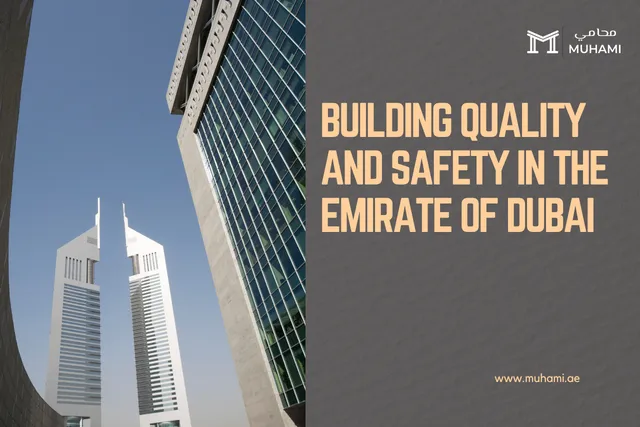
With the issuance of Law No. (3) of 2026 concerning Building Quality and Safety in the Emirate of Dubai, the Emirate is moving towards a new phase in regulating the built environment, based on a key principle: building safety is no longer limited to the construction and permitting stage, but extends throughout the building’s lifecycle to ensure safe and sustainable operation.
Mandatory Safety Certificates for Buildings 20+ Years Old
Under this law, owners of buildings that are 20 years or older are required to obtain a Quality and Safety Certificate from the competent authority, following a comprehensive technical and structural assessment conducted by a qualified engineering consultancy. This assessment covers, in particular:
- Structural integrity,
- External cladding condition,
- Electrical and mechanical systems,
- Facade elements and safety barriers,
- Civil defence requirements and security monitoring systems.
The law also regulates the validity periods of this certificate, setting it at 10 years for buildings less than 40 years old, and 5 years for older buildings, with the possibility of renewal in accordance with applicable requirements.
Technical Assessments & Structural Integrity Requirements
Additionally, the law imposes clear obligations on the building owner — or the management entity in jointly owned properties — to appoint a qualified consultant and contractor, and to carry out maintenance and rectification works within specified timeframes. Authorities are also empowered to order evacuation of the building where necessary to facilitate required repairs.
Compliance Penalties: Fines Up to AED 2 Million
To ensure compliance, the law grants the competent authorities broad regulatory powers, including the suspension of building-related transactions or permits, and the imposition of fines of up to AED 1,000,000, which may be doubled to AED 2,000,000 in case of repeat violations.
From a practical perspective, the law introduces several key implications:
For owners and developers, the need to adopt a structured approach to building lifecycle management, including periodic assessments, preventive maintenance planning, and appropriate budget allocation.
- For owners and developers, the need to adopt a structured approach to building lifecycle management, including periodic assessments, preventive maintenance planning, and appropriate budget allocation.
- For owners’ associations and property managers, the importance of reviewing management and maintenance contracts, as well as service charge budgets, to ensure alignment with the new quality and safety certification requirements.
- For engineering consultancies and contractors, the necessity to enhance technical readiness and establish clear frameworks for professional responsibility when issuing technical reports and carrying out remedial works.
Can my landlord increase rent after safety renovations under Law No. 3 of 2026?
One of the most significant protections introduced by the new law is the “Right of Return.” If a building requires major maintenance or structural rectification to meet the new safety standards, the law clarifies that:
- Priority for Occupants: Tenants have the priority to return to their units once works are completed.
- Rent Stability: Tenants are entitled to return at the same previous rental value unless a different agreement was reached.
This clause ensures that the drive for building safety does not become a backdoor for “renoviction” or unjustified rent hikes, balancing the Emirate’s safety goals with tenant security.
Tenant Rights: Rent Protection During Major Renovations
Notably, the law also addresses tenant protection. In cases involving demolition or major maintenance works, occupants are granted priority to return to the building at the same previous rental value, unless otherwise agreed. This strikes a balance between safety requirements and the protection of tenants’ interests.
Based on the above, this law represents a pivotal step towards:
- Enhancing the safety and sustainability of Dubai’s real estate stock,
- Reducing structural and operational risks, particularly in older buildings,
- Elevating the urban landscape in line with the Emirate’s standing and its advanced construction and urban development standards.
Accordingly, it is advisable for all stakeholders — including owners, management entities, consultants, and contractors — to proactively review the status of their buildings and develop a clear timeline for compliance within the statutory grace period. This will help avoid penalties, prevent disruption to transactions, and ensure the long-term sustainability of their real estate assets.
Any Questions?
Connect with lawyers and seek expert legal advice
Share
Find by Article Category
Browse articles by categories
Related Articles
What Most People Don't Know About CBDCs
Imagine waking up one morning to discover that the cash in your wallet has beco…
What Most People Don't Know About CBDCs
Imagine waking up one morning to discover that th…
Family Foundations & Tax treatment in t…
A correctly structured Family Foundation can be a powerful tool for holding U…
Family Foundations & Tax treatment in the UAE
A correctly structured Family Foundation can be…

Accepting Crypto Payments in the UAE: M…
Quick Answer A UAE business cannot simply accept cryptocurrency for its good…
Accepting Crypto Payments in the UAE: Merchant Sa…
Quick Answer A UAE business cannot simply acce…

LEGAL SAFETY RULES — Issue 17 — When …
At the airport, everything moves quickly. A long queue. A sli…
LEGAL SAFETY RULES — Issue 17 — When a Simple F…
At the airport, everything moves quickly. …

LEGAL SAFETY RULES — Issue 18 — AI Ca…
There is a growing trend that many people do not talk about enough. Wh…
LEGAL SAFETY RULES — Issue 18 — AI Can Write. B…
There is a growing trend that many people do not …
One Country, Multiple Court Systems: A …
Ask a newly arrived general counsel to sketch the UAE court system on a whitebo…
One Country, Multiple Court Systems: A Practition…
Ask a newly arrived general counsel to sketch the…