
Dirham Stablecoin and USDT: The Ultimate Guide for UAE Investors in 2025 The Dawn of a New Financial Era in the UAE
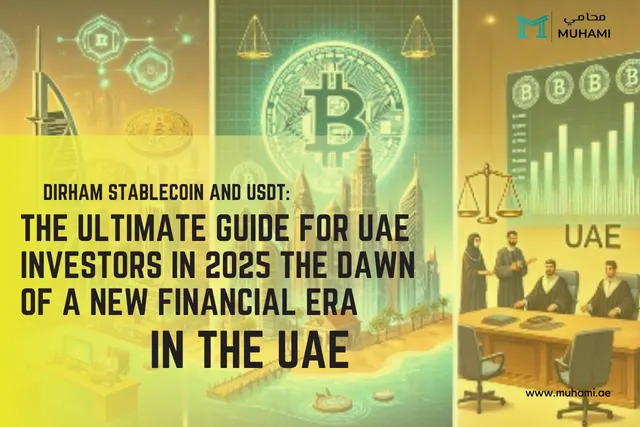
The Dawn of a New Financial Era in the UAE
The United Arab Emirates' financial landscape is undergoing a seismic shift. The long-anticipated launch of a regulated, Dirham-pegged stablecoin is now a reality, marking a pivotal moment in the nation's ambitious strategy to establish itself as a premier global hub for digital assets. For the millions of crypto investors, traders, and businesses in the region, this development introduces a critical decision point: should they adhere to Tether (USDT), the globally dominant stablecoin that has long served as the market's default liquidity instrument, or embrace the new, locally-regulated alternative?
The answer is not a simple preference but a strategic choice dictated by a new wave of sophisticated regulations, specific transactional needs, and an evolving definition of risk and trust in the digital economy.
Before comparing these assets, it is crucial to clarify a point of common confusion. The UAE is pursuing a sophisticated, dual-track digital currency strategy. The first track is the "Digital Dirham," the nation's official Central Bank Digital Currency (CBDC). This is a direct liability of the Central Bank of the UAE (CBUAE), representing the sovereign digital equivalent of physical cash, designed to modernize the core financial infrastructure for interbank and, eventually, retail payments.
The second track, and the focus of this guide, involves "Dirham Payment Tokens." These are stablecoins issued by private, licensed entities, such as commercial banks and financial technology firms, under the stringent supervision of the CBUAE's Payment Token Services Regulation (PTSR). These Dirham Payment Tokens are the direct, regulated competitors to offshore stablecoins like USDT.
This dual approach is not redundant, it is a deliberate act of national economic policy. The CBUAE is constructing a government-controlled foundational layer (the Digital Dirham) while simultaneously fostering a competitive, regulated market for consumer-facing products (Dirham Payment Tokens) to operate on top. This allows the UAE to harness the innovative potential of blockchain technology without ceding monetary control to foreign entities or decentralized protocols. The choice for investors in 2025, therefore, is not merely between two coins, but between two fundamentally different financial and regulatory philosophies. This guide provides the definitive framework for navigating that choice.
Profiling the Contenders: Global Incumbent vs. National Champion
The contest between the Dirham stablecoin and USDT is a classic case of an entrenched global leader facing a challenge from a highly specialized, government-backed local champion. Understanding their distinct characteristics, from reserve composition to regulatory standing, is essential for any market participant in the UAE.
Tether (USDT) - The Global Liquidity Engine
Tether (USDT) is, by virtually every measure, the incumbent heavyweight. As the world's largest stablecoin by market capitalization, it is pegged 1:1 to the U.S. Dollar and functions as the indispensable lubricant for the global crypto economy. Its primary utility lies in providing a stable store of value and a universal unit of account for traders moving between volatile crypto assets. It is the most common trading pair on nearly every international exchange and serves as the foundational collateral asset across the sprawling landscape of decentralized finance (DeFi), making it essential for activities like lending, borrowing, and yield farming.
Historically, USDT's reputation was shadowed by persistent questions regarding the transparency and quality of its reserves. However, in recent years, Tether has made significant strides to bolster confidence. Its latest 2025 attestation reports, conducted by the top-five accounting firm BDO, reveal a dramatic improvement in its reserve quality. The portfolio is now dominated by highly liquid assets, with total exposure to U.S. Treasuries exceeding $127 billion, positioning Tether as one of the largest holders of U.S. government debt globally. While this has substantially mitigated risk, the reserve composition remains complex. It includes smaller but notable allocations to other assets such as secured loans, precious metals, and Bitcoin, which introduce a degree of valuation complexity and opacity not present in more conservative models.
Within the UAE, USDT's regulatory status is nuanced. It is not locally issued or directly regulated as a payment instrument by the CBUAE. Its legal standing is one of recognition for specific, limited purposes. For instance, the Financial Services Regulatory Authority (FSRA) in the Abu Dhabi Global Market (ADGM) has designated USDT as an "Accepted Virtual Asset," permitting licensed firms within that free zone to use it for approved services. Similarly, on exchanges licensed by Dubai's Virtual Assets Regulatory Authority (VARA), USDT is widely available and permitted for its core function: as a means of payment for the purchase of other virtual assets or their derivatives. This creates a critical distinction: USDT is tolerated as a trading instrument but is not licensed as a universal payment token for general commerce.
The Dirham Stablecoin - The Regulated Safe Haven
The Dirham stablecoin, formally known as a "Dirham Payment Token" under the CBUAE framework, represents a new paradigm of regulatory integration. Pegged 1:1 to the UAE Dirham, it is designed from the ground up to serve as a trusted and compliant digital payment instrument for the domestic economy. Several major players have announced initiatives to issue these tokens, including a powerful consortium of First Abu Dhabi Bank (FAB), sovereign wealth fund ADQ, and International Holding Company (IHC), as well as a separate collaboration between the ADX-listed Phoenix Group and Tether itself.
The decision by Tether to partner in launching a compliant AED stablecoin is a telling strategic maneuver. Faced with regulations that curtail USDT's utility for local payments, the organization has opted to compete within the new framework rather than be excluded from it. This effectively means the market will see competition not just between a Dirham stablecoin and USDT, but between different, locally-licensed Dirham stablecoin issuers.
The core value proposition of any Dirham Payment Token lies in its regulatory bedrock. The CBUAE's Payment Token Services Regulation (PTSR) and VARA's Virtual Asset Issuance Rulebook impose some of the strictest standards for stablecoin issuers in the world. Key mandates include:
Ironclad Reserve Requirements: Issuers must maintain a reserve of high-quality liquid assets with a value that is, at all times, at least equal to the total face value of all payment tokens in circulation. These assets must be held in segregated accounts with a third-party custodian, protecting them from misappropriation.
Unprecedented Audit and Reporting Frequency: Unlike the quarterly attestations common in the industry, licensed Dirham stablecoin issuers are subject to daily reconciliation of their reserves, with reports submitted directly to the CBUAE. Furthermore, they must undergo a comprehensive audit by an independent, external auditor on a monthly basis to confirm full backing. This creates a level of transparency and accountability far exceeding that of any major global stablecoin.
Strict Issuer Licensing: Any entity wishing to issue a Dirham Payment Token must be incorporated in the UAE and obtain a specific license from the CBUAE. This process involves demonstrating significant regulatory capital (often starting at AED 5 million to AED 10 million), implementing robust Anti-Money Laundering and Counter-Financing of Terrorism (AML/CFT) systems, and ensuring operational resilience.
Crucially, this robust regulatory framework endows the Dirham stablecoin with a unique legal status. It is the only form of stablecoin legally sanctioned for use in universal payments for goods and services across the UAE, positioning it to become the default digital instrument for everything from retail purchases and B2B invoices to payroll and remittances.
The Definitive Head-to-Head Analysis
A direct comparison reveals two assets designed for fundamentally different purposes, operating under vastly different regulatory regimes. For UAE-based users, the choice hinges on a trade-off between global liquidity and local compliance.
Regulatory Oversight and Investor Protection
The disparity in regulatory oversight is the most significant differentiator. The Dirham stablecoin operates under the direct and comprehensive supervision of the UAE's highest financial authorities, the CBUAE and VARA. This provides users with a clear and robust framework for investor protection. The regulations are explicitly designed to prevent market abuse, ensure issuer solvency, and provide legal recourse through established local channels, such as VARA's Grievance Committee. In contrast, USDT is regulated offshore, primarily in the British Virgin Islands. While it has gained recognition from bodies like ADGM's FSRA, the ultimate oversight and legal jurisdiction lie outside the UAE. For a UAE-based user, seeking recourse in the event of a dispute or issuer failure would be a complex, cross-border legal challenge.
Trust, Transparency, and Reserve Quality
Trust in a stablecoin is a direct function of the transparency and quality of its reserves. The Dirham stablecoin model is built on a foundation of unambiguous, legally mandated transparency. The requirements for daily reporting to the CBUAE and monthly external audits provide a near real-time, verifiable guarantee of 1:1 backing. The composition of the reserves is strictly defined to include only high-quality, low-risk liquid assets.
USDT, while vastly improved, operates on a model of periodic disclosure. Its quarterly attestations provide a snapshot of its financial position at a single point in time, offering less frequent assurance than the CBUAE's continuous oversight model. The diverse nature of its reserve portfolio, which includes assets like Bitcoin and secured loans alongside U.S. Treasuries, introduces a layer of valuation risk and complexity that is explicitly designed out of the Dirham stablecoin framework.
Market Liquidity and Ecosystem Integration
This is the one arena where USDT maintains an insurmountable lead for the foreseeable future. With a market capitalization exceeding $150 billion, USDT offers unparalleled global liquidity. It is the lifeblood of international crypto exchanges and the primary on-ramp to the global DeFi ecosystem. Any trader or DeFi user requires access to USDT's deep liquidity pools to operate effectively at a global scale.
The Dirham stablecoin's liquidity, at least initially, will be concentrated within the UAE's domestic ecosystem. Its key strength will be its seamless integration with local banking infrastructure, allowing for frictionless on- and off-ramping between the digital token and traditional AED bank accounts. While this provides immense utility for local users, its acceptance and liquidity on international exchanges and DeFi platforms will be minimal at launch, limiting its utility for global-facing activities.
Permitted Use Cases and Transactional Utility
Regulatory frameworks create clear boundaries for how these assets can be used legally within the UAE. The CBUAE's PTSR explicitly restricts the use of "Foreign Payment Tokens" like USDT. After the transitional period ends in mid-2025, its lawful use will be confined primarily to the purchase of other virtual assets and their derivatives on licensed platforms. While it is currently used for a broader range of peer-to-peer and B2B payments, such activities will fall outside the bounds of compliance.
Conversely, the Dirham stablecoin has been purpose-built and legally sanctioned for universal use as a means of payment within the UAE. It is designed to facilitate all forms of local commerce, including retail transactions, B2B invoice settlement, employee salaries, and cross-border remittances originating from or terminating in the UAE. It is poised to become the primary digital payment rail for the nation's economy.
|
Feature |
Tether (USDT) |
UAE Dirham Stablecoin |
|
Peg & Currency |
Pegged 1:1 to the US Dollar ($) |
Pegged 1:1 to the UAE Dirham (AED) |
|
Primary Regulator |
Offshore Authorities (e.g., BVI) |
Central Bank of the UAE (CBUAE) & VARA |
|
Reserve Backing |
Mix: U.S. Treasuries, cash, secured loans, Bitcoin, etc. |
Mandated: High-quality liquid assets, fully compliant with strict CBUAE rules |
|
Audit Frequency |
Quarterly Attestation by BDO |
Daily reconciliation to CBUAE; Monthly external audit |
|
Legal Use in UAE |
Primarily for trading other virtual assets |
Universal payments: retail, payroll, remittances, B2B |
|
Key Advantage |
Unmatched global liquidity and DeFi integration |
Highest level of local regulatory safety and seamless AED banking |
|
Main Drawback |
Regulatory ambiguity and restricted local payment utility |
Lower initial liquidity and acceptance outside the UAE |
The Investor's Playbook: A Profile-Based Recommendation Guide
The introduction of the Dirham stablecoin does not signal the end of USDT in the UAE. Rather, it heralds the bifurcation of the market into two distinct ecosystems: a regulated, onshore transactional economy and a global, offshore speculative economy. Sophisticated users will likely need to hold and use both assets, selecting the appropriate tool for the specific task at hand.
Profile 1: The UAE-Based Enterprise (SMEs & Corporations)
For any business operating within the UAE, the Dirham stablecoin should be the default choice for domestic financial operations. For functions like paying employee salaries, settling invoices with local suppliers, and managing corporate treasury, it is the only fully compliant and operationally superior option. Using a Dirham-pegged asset eliminates the currency risk and accounting complexities associated with holding a USD-pegged stablecoin like USDT. Furthermore, its programmability allows for the automation of complex payment flows, such as conditional vendor payments and instant payroll distribution, significantly enhancing treasury efficiency.1
Profile 2: The Active Global Crypto Trader & DeFi Participant
For individuals and firms whose primary activities are high-frequency trading on international exchanges and participation in global DeFi protocols, USDT remains the indispensable tool. USDT will have th4e advantage of possessing the deep, cross-exchange liquidity necessary for efficient arbitrage, and integrated as a primary collateral type in major DeFi platforms like Aave or Compound at launch. For these users, USDT is the non-negotiable standard for accessing the global digital asset market.
Profile 3: The Remittance User (Sending/Receiving Funds)
Remittance users should adopt a hybrid strategy based on the direction of the fund flow. For remittances sent into the UAE, converting foreign currency into a Dirham stablecoin upon arrival will likely become the most efficient method for final settlement into a local AED bank account. For sending funds out of the UAE to countries where USDT has high adoption and liquidity (such as in parts of Latin America or Southeast Asia), USDT may continue to be the faster and more cost-effective option than traditional banking rails. This landscape may evolve as the CBUAE develops its own bilateral CBDC payment bridges.
Profile 4: The Digital Real Estate Investor
Investors in Dubai's burgeoning tokenized real estate market should prepare to transition to the Dirham stablecoin. While early transactions have been conducted using assets like Bitcoin and USDT, the strong regulatory push from VARA and the Dubai Land Department (DLD) will inevitably favor the use of a locally regulated, legally unambiguous payment instrument. Using the Dirham stablecoin will provide greater legal certainty for transactions, simplify the management of escrow via smart contracts, and align perfectly with the government's long-term vision of a fully blockchain-powered property registration and transfer system.21
Conclusion: A Strategic Choice for a Global Crypto Hub
The debate over the Dirham stablecoin versus USDT is not about which asset is inherently "better," but which is the "right tool for the right job." The analysis makes it clear that these two stablecoins are set to dominate separate spheres of the UAE's digital economy. The Dirham stablecoin is unequivocally the future of local commerce and regulated domestic finance, offering unparalleled safety, transparency, and integration with the UAE's banking system. USDT, in turn, will retain its crown as the undisputed king of global trading, cross-border liquidity, and decentralized finance.
The launch of a CBUAE-regulated Dirham stablecoin is a landmark moment, signaling the maturation of the UAE's digital asset market from a speculative frontier to a functional, regulated economy. This development does not eliminate choice, it enhances it, providing businesses and investors with a spectrum of tools tailored to specific needs. By creating a world-class framework for safe, domestic digital payments while maintaining an open door for global liquidity instruments, the UAE has powerfully reinforced its strategic ambition to be the world's most sophisticated and well-regulated hub for the future of finance.
Disclaimer: The content of this blog is intended for informational purposes only and does not constitute formal legal advice. While every effort is made to ensure accuracy, the material is general in nature and may not reflect the most recent legal developments. No lawyer-client relationship is formed by reading or relying on this content. If you require legal assistance tailored to your specific situation, you are advised to consult directly through an appropriate channel.Any Questions?
Connect with lawyers and seek expert legal advice
Share
Find by Article Category
Browse articles by categories
Find Article by Practice Area
Browse articles by practice area
Related Articles
What Most People Don't Know About CBDCs
Imagine waking up one morning to discover that the cash in your wallet has beco…
What Most People Don't Know About CBDCs
Imagine waking up one morning to discover that th…
Accepting Crypto Payments in the UAE: M…
Quick Answer A UAE business cannot simply accept cryptocurrency for its good…
Accepting Crypto Payments in the UAE: Merchant Sa…
Quick Answer A UAE business cannot simply acce…
Dubai Commodity Tokenisation: Do You Ow…
The short answer is: it depends on how the token is built, and Dubai's rule…
Dubai Commodity Tokenisation: Do You Own the Comm…
The short answer is: it depends on how the token …

Shareholder Disputes in UAE Companies: …
If you are caught in a shareholder dispute in a UAE company, your options depen…
Shareholder Disputes in UAE Companies: Exit, Dead…
If you are caught in a shareholder dispute in a U…
Debt Collection vs Debt Recovery in the…
If you run a business in the UAE for long enough, you will eventually face the …
Debt Collection vs Debt Recovery in the UAE: What…
If you run a business in the UAE for long enough,…

How to Choose a Commercial Lawyer in Du…
If you are comparing commercial lawyers in Dubai, finding names is rarely the p…
How to Choose a Commercial Lawyer in Dubai: Pract…
If you are comparing commercial lawyers in Dubai,…