
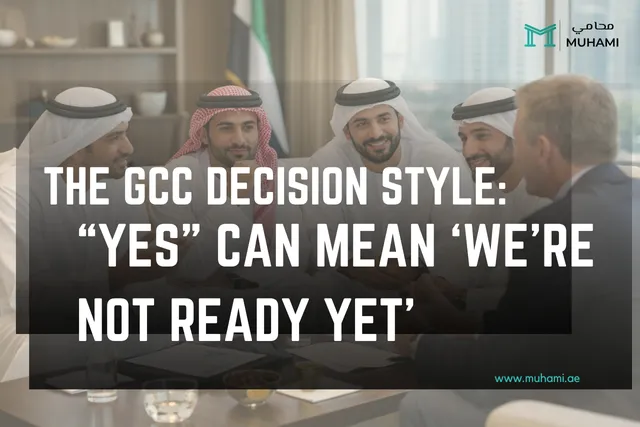
The GCC Decision Style: “Yes” Can Mean ‘We’re Not Ready Yet’
Most international advisors know Ramadan is important in the Gulf.
They know working hours shift. They know not to eat in front of clients. They know to say "Ramadan Kareem."
And they think that's enough.
It isn't.
Knowing is the easy part. Ramadan tests something deeper: whether your cultural intelligence is something you perform when it's convenient, or something that has genuinely changed how you show up.
Your GCC clients notice the difference. They just rarely say so.
The Test You Didn't Know You Were Taking
Ramadan compresses everything that matters in Gulf advisory relationships into a single month.
Tempo slows. Communication becomes more layered. Decisions that seemed imminent go quiet. The client who returned calls within hours now takes days. The deal that was moving enters a reflective pause.
This is where most international advisors fail, not through ignorance, but through impatience dressed as professionalism.
The urgent follow-up email at 2 pm. The "just checking in" text that arrives mid-fast. The request to "lock something in before Eid" that signals, loudly, that the advisor's timeline matters more than the client's reality.
None of this is malicious. But all of it is noticed.
Because in the Gulf, how you behave when things slow down reveals more about your character than how you perform when things are moving.
Knowing vs. Doing: The Gap That Costs Advisors Relationships
There's a version of cultural awareness that's essentially cosmetic. The advisor who adds "Ramadan Mubarak" to their email signature, declines lunch meetings, and considers the box ticked.
Then there's cultural fluency, the kind that reshapes behavior at a structural level.
It's the advisor who, without being asked, reschedules a pressured call that was set for the last hour of fasting. Who sends a brief, warm message not to chase a decision but simply to acknowledge the month. Who understands that the silence on a file isn't disengagement, it's often the sound of a decision being considered carefully, in the right circles, at the right time.
I've watched senior partners from top-tier firms lose significant GCC relationships not through bad legal work but through the steady accumulation of small signals that said: "I understand your culture in theory. But I'm not willing to let it inconvenience me in practice."
That distinction is career-defining in this market.
Patience vs. Urgency: The Tempo Mismatch That Reveals Everything
Ramadan creates a natural deceleration. Internal meetings are fewer. Decision-makers are less accessible. Approvals that require a physical gathering wait until conditions are right.
International advisors trained in deal velocity - in the rhythm of London or New York - often experience this as a problem to solve.
It isn't. It's a context to respect.
The advisors who thrive during Ramadan understand something fundamental: in the Gulf, patience is not passivity. It is a signal of trust. It says, "I understand how decisions are made here, and I'm not going to undermine your process because my deadline is uncomfortable."
The advisors who struggle send the opposite signal. They push for "quick decisions." They escalate through intermediaries. They reframe delays as risks to the client, which might be technically accurate but is culturally tone-deaf in the context of a sacred month.
Here's what the best advisors know:
The relationship you protect during Ramadan is worth more than the clause you pushed through before Eid.
Presence vs. Performance: The Question Clients Are Actually Asking
There's a question Gulf clients ask about every advisor they work with, but almost never ask out loud:
Are you here because you understand us, or because you want our business?
Ramadan is when that question gets answered, not by what you say, but by the texture of everything you do.
The advisor who sends a thoughtful Ramadan message with no ask attached. Who doesn't schedule the 8 am call because they remember Suhoor. Who follows up after Eid not to chase a matter but to ask how the month was, and genuinely means it.
These aren't soft gestures. In a market built on long-term relationships and reputation, they are commercial strategy executed with human warmth.
The clients who trust their most sensitive matters to one advisor over another rarely cite technical excellence as the deciding factor. They cite something harder to name; a sense that this person genuinely gets it. That they're not performing respect for the Gulf; they've internalized it.
Ramadan is the month that test plays out most visibly.
What To Do Differently, Starting Now
Restructure your outreach tempo: Move non-urgent communication to post-iftar hours or early morning. If something can wait, let it wait. If it genuinely cannot, acknowledge the timing: "I'm aware this comes at a busy time in the month, I wouldn't reach out unless it required attention."
Replace "checking in/circling back" with presence: One warm, non-transactional message during Ramadan outperforms ten follow-ups. It doesn't ask for anything. It simply says: I see you, I respect this month, and I'm here when you need me.
Reframe the silence: When a file goes quiet, resist the instinct to escalate. Ask yourself: is this a deal in trouble, or a decision being made in the way decisions are made here? The answer is usually the latter.
Design your Eid moment carefully: An Eid message sent the day of, personalized, and with no attached ask is one of the most underused relationship tools in Gulf advisory practice. It should not look like a newsletter. It should look like you remembered.
Brief your team: Cultural fluency cannot stop at the senior partner or board advisor. If a junior associate is sending aggressive timeline emails while you're sending warm Ramadan messages, the client experience is contradictory. Make sure your whole team understands the month's rhythm.
Ramadan doesn't ask international advisors to compromise their professional standards.
It asks something harder: to demonstrate that you've genuinely absorbed a different way of understanding time, trust, and the relationship between the two.
The advisors who get this don't just survive Ramadan in the GCC.
They emerge from it with something that can't be bought, pitched, or billed for.
They emerge trusted.
Ramadan Mubarak.
If this resonated, The GCC Legal Culture Review goes deeper every Tuesday, subscriber-only frameworks, cultural tools, and advisory insights for legal professionals operating across the Gulf. Join at gcclcr.com
Any Questions?
Connect with lawyers and seek expert legal advice
Share
Find by Article Category
Browse articles by categories
Find Article by Practice Area
Browse articles by practice area
Related Articles
Digital Marketing - Guide and Overview …
Quick Answer: Digital marketing encompasses brand promotion through the interne…
Digital Marketing - Guide and Overview 2026
Quick Answer: Digital marketing encompasses brand…

Social Media Around the World: What the…
If you’re a business owner or just someone curious about social media, yo…
Social Media Around the World: What the Numbers S…
If you’re a business owner or just someone …

8 Free AI Image Generator Showdown: Whi…
AI image generators have revolutionised creativity, making it easier than ever …
8 Free AI Image Generator Showdown: Which Platfor…
AI image generators have revolutionised creativit…

What is a Social Media Hook and Why it …
A social media hook is a short and catchy part at the beginning of an…
What is a Social Media Hook and Why it Matters?
A social media hook is a short and catc…
Unlocking Social Media Success: 7 Strat…
Imagine this: you’re scrolling through social media, bombarded by countle…
Unlocking Social Media Success: 7 Strategies You …
Imagine this: you’re scrolling through soci…

Enhancing Your Restaurant’s Online Pres…
In today’s digital age, having a strong online presence is crucial for th…
Enhancing Your Restaurant’s Online Presence: A Gu…
In today’s digital age, having a strong onl…